You Don’t Need Permission to Protect Your Mental Health

Updated: Aug 23
Why caring for your emotional well-being should not require an explanation, apology or breaking point.

Many women have learned to treat their mental health as something they are allowed to address only after everything else has been handled. They will rearrange their schedules for appointments, family obligations, work emergencies and other people’s needs, yet hesitate to protect an hour for themselves unless they can defend why they need it.
We tell ourselves that we are managing. We are still getting out of bed, answering messages, meeting deadlines and doing what everyone expects of us. We assume that because we are functioning, we must be fine. Meanwhile, we may be sleeping poorly, becoming irritated by ordinary requests, losing interest in things we once enjoyed or feeling overwhelmed by decisions that should not be particularly difficult.
We often wait for something dramatic to happen before taking those feelings seriously. We wait until we cannot stop crying, cannot concentrate, cannot keep up or cannot pretend that everything is fine for one more day. Only then do we feel justified in admitting that we need rest, support or change.
But you do not have to be falling apart before you begin taking care of your mental health. You do not need anyone else to agree that you are overwhelmed. You do not need to prove that your life is unusually difficult, and you do not need permission to protect the part of you that carries you through it. Mental health deserves attention while you are still functioning—not only after functioning becomes impossible.
1. Ask Yourself Whether You Are Actually Fine
“How are you?” is often a casual greeting rather than an invitation to reveal everything you are feeling. You do not owe every acquaintance, coworker or person you pass during the day a detailed explanation of your emotional state. Protecting your privacy is not the same as being dishonest.
You can smile and say that you are fine without laying every emotion on the table. The more important conversation is the one you have with yourself. At some point during the day, pause and ask: Am I actually fine? Am I simply tired after a demanding week, or have I been emotionally exhausted for months? Am I handling a difficult season, or am I barely holding myself together? Do I need rest, support, a change in circumstances or help from a professional?
It is possible to become so accustomed to saying that you are fine that you stop noticing when you are not. Acknowledging the truth does not require announcing it to everyone. It simply means refusing to hide it from yourself.
You are allowed to keep your feelings private. You are also allowed to admit—to yourself and to the people you genuinely trust—that you are not fine. That quiet honesty is often the first step toward understanding what you need.
2. Identify What Repeatedly Drains You
Not every difficult day signals a deeper problem, but repeated patterns deserve attention. Notice the situations, responsibilities and relationships that consistently leave you depleted.
Perhaps one person contacts you only when something needs to be solved. Maybe a volunteer commitment that once felt meaningful now fills you with dread. Your workload may have expanded gradually until an unreasonable amount of responsibility began to feel normal. You may also be consuming so much distressing information that your mind never receives a break from problems you cannot personally solve.
You do not need to eliminate every demanding part of life. Some responsibilities cannot simply be abandoned. But identifying what drains you allows you to stop treating the resulting exhaustion as a personal failure.
Once you recognize a pattern, you can begin asking a more useful question. Instead of wondering why you are not handling everything better, ask whether everything you are handling still belongs to you.
3. You Don’t Have to “Earn Your Pillow”
I often remind myself that I do not have to earn my pillow. I do not have to solve every problem, complete every task or make everyone else comfortable before I am allowed to rest.
Too many of us approach bedtime as though it is a finish line we can cross only after everything has been handled. We tell ourselves we can lie down after the laundry is finished, the messages are answered, the kitchen is clean and tomorrow’s problems have already been anticipated. The trouble is that life is rarely finished. There will always be another responsibility waiting for us in the morning.
Some problems need to remain unsolved overnight. Some decisions will be clearer after sleep. Some chores can wait without anything terrible happening. Resting before everything is complete is not irresponsible; it is an acknowledgment that you are a human being with limits.
Your exhaustion does not have to become extreme before rest is justified. The pillow is already yours. You do not have to earn it.

4. Set One Boundary Before Resentment Sets It for You
When we repeatedly agree to things we do not have the capacity to manage, resentment eventually begins speaking on our behalf. It appears as irritability, avoidance, emotional withdrawal or an outburst that seems disproportionate to the immediate situation.
A boundary delivered earlier is usually kinder than resentment delivered later.
Choose one area in which you need a clearer limit. It might involve how quickly you answer messages, how often you change your plans, what responsibilities you are willing to accept or which problems you will no longer solve for another capable adult.
You do not need an elaborate explanation. “I’m not able to do that” is information, not an invitation to debate whether your reason is acceptable. Other people may be disappointed by your boundary, but their disappointment does not automatically mean you have done something wrong.
5. Reduce the Noise You Allow Into Your Day
Our minds were not designed to absorb an uninterrupted stream of breaking news, opinions, requests, advertisements, comparisons and notifications. Yet many of us begin consuming information before we get out of bed and continue until the moment we try to sleep.
Consider what your mind is being asked to process every day. Does every notification need to be immediate? Do you need to know every upsetting development as it happens? Are certain accounts leaving you informed and inspired, or anxious and inadequate?
Turning down the noise does not mean becoming uninformed or disconnected. It means becoming more deliberate about what receives access to your attention. You can care about what is happening in the world without allowing every development to occupy your thoughts all day. Your peace should not be available to every person, platform and headline that demands it.
6. Make Room for Something That Belongs to You
A life filled entirely with obligations can slowly become emotionally colorless. You may be busy from morning until night while feeling that very little of your day actually belongs to you.
Protect something small that exists because you enjoy it. Read, garden, pray, create, walk, listen to music or sit outside without turning the moment into another self-improvement assignment. The activity matters less than the experience of choosing it for yourself.
Not every hour has to produce something useful. Not every interest has to become a project, side business or service for someone else. You are allowed to do something simply because it makes you feel more like yourself. Pleasure is not frivolous. It reminds you that you are more than the work you complete and the people you assist.

7. Let Someone Know When You Are Struggling
There is a difference between sharing your private emotions with everyone and being honest with someone you trust. You do not have to make your inner life public, but you also should not have to carry every difficult feeling alone.
Independence can become isolating when it convinces us that needing support is evidence that we are not coping well enough. We may quietly hope that someone will notice what we are going through while working very hard to ensure that no one can.
Choose someone trustworthy and tell the truth. You do not have to disclose everything or ask that person to fix the situation. You might simply say, “I have been having a harder time than I have let people know.”
Being witnessed does not solve every problem, but it interrupts the loneliness of carrying everything privately. It gives the people who care about you an opportunity to respond to what is actually happening rather than the capable appearance you have maintained.
8. Seek Professional Help Before You Reach Your Breaking Point
Professional mental health care is not reserved for people whose lives have completely unraveled. A qualified therapist, counselor or medical professional can help when anxiety, depression, grief, stress or emotional exhaustion begins affecting your daily life, relationships, sleep or ability to function.
Seeking help is not an admission that you have failed to manage your own life. It is a decision to stop managing something alone when appropriate support is available.
You would not expect yourself to diagnose and treat every physical health concern without professional guidance. Your mental health deserves the same seriousness and care. You do not have to wait until the situation becomes unbearable before deciding that support would be useful.
Taking Yourself Seriously
Protecting your mental health will sometimes inconvenience other people. A boundary may require someone to make different arrangements. Your decision to rest may mean that a task remains unfinished. Asking for help may challenge the image of you as the person who can always handle everything. That discomfort does not mean your decision is wrong.
You are allowed to notice what your life is doing to you. You are allowed to question roles and expectations that have become emotionally expensive. You are allowed to make changes before exhaustion, resentment or burnout makes them for you.
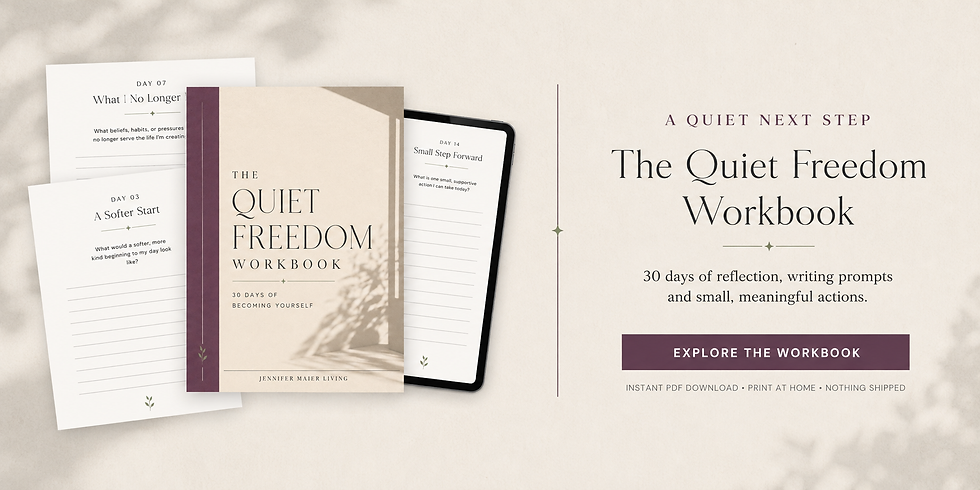
If you are ready to examine those patterns more closely, The Quiet Freedom Workbook offers a private, guided place to explore the expectations you have carried, the roles you may have outgrown and the changes that could help you create more room for yourself. It is not a replacement for professional mental health care. It is a tool for honest reflection—for listening to yourself before reaching the point when your mind and body have to demand your attention.
You do not have to reveal everything you are feeling to everyone who asks how you are doing. You do not have to explain every boundary or convince anyone that your exhaustion is legitimate. But you do owe yourself the honesty of asking whether you are truly fine—and the compassion to respond when the answer is no.
You do not have to prove that you are struggling enough. You do not have to wait until you can no longer function. Caring for your mental health is not something another person must approve. It is a responsibility you are allowed to take seriously now.
This essay and The Quiet Freedom Workbook are intended to encourage personal reflection and general emotional well-being. They are not medical advice and are not substitutes for diagnosis, treatment, therapy or care from a qualified healthcare or mental health professional.
If you are struggling, experiencing persistent emotional distress or finding it difficult to manage daily life, please reach out to a licensed mental health professional or healthcare provider. You do not have to wait until you reach a breaking point to ask for help.



Comments