The Cost of Always Being the Easy One

Updated: Aug 23
What happens when being agreeable, dependable and undemanding begins to cost more than anyone realizes—including you.

There is usually one person in every family, workplace or circle of friends who makes life easier for everyone else. She adjusts her schedule when plans change. She remembers what other people forget. She takes care of the loose ends, avoids unnecessary conflict and rarely asks anyone to rearrange their life for her.
People appreciate her. They may even describe her as flexible, dependable or wonderfully low-maintenance. She is not invisible, and she has not disappeared. In many ways, she is one of the most visible and relied-upon people in the room.
What others may not see is what it costs her to remain that accommodating.
They see the problem solved, the gathering organized, the appointment remembered and the schedule rearranged. They do not necessarily see the mental calculations behind it all—the plans she changed, the rest she postponed or the disappointment she swallowed because speaking up felt more difficult than simply handling it herself.
The woman carrying the load may not recognize the toll either.
When you have been capable for a long time, carrying more can begin to feel normal. You become so accustomed to anticipating needs and making adjustments that you stop considering them sacrifices. You simply do what needs to be done and move on to the next thing.
That is how being “the easy one” becomes more than a personality trait. It becomes a role.

When Capability Hides the Cost
Being dependable is not a flaw. Kindness, patience and flexibility are qualities worth keeping. The problem begins when everyone—including you—starts treating your capacity as though it has no limit.
Capable people are often given more because they make difficult things look easy. If you rarely complain, others may reasonably assume that you are fine. If you always say yes, they may not realize that you wanted to say no. If you routinely change your plans without mentioning the inconvenience, no one sees what their request required from you.
This does not always mean the people around you are selfish or deliberately taking advantage of you. Sometimes they have simply learned the version of you that you have consistently presented: the woman who can handle it, does not mind and will make everything work.
Eventually, however, the difference between what you can technically manage and what you can continue carrying without harm becomes impossible to ignore.
The warning signs may appear quietly. You become irritated by ordinary requests. You dread hearing your phone ring because it may mean someone needs something. You have difficulty enjoying the time you finally get to yourself because you are too depleted to use it. Even small decisions feel exhausting because your mind has been making decisions for everyone else all day.
Then one seemingly minor demand becomes more than you can bear. You may cry, become angry or feel an overwhelming urge to walk away from everything for a while. The reaction can seem out of proportion to what just happened—but it is rarely about that one request.
It is about the accumulated weight of all the requests that came before it.
Burnout is often the first undeniable evidence that being the easy one has not been easy at all.
You May Not Know What You Need Anymore
Another consequence of constantly accommodating other people is that your own preferences can become difficult to identify.
When someone asks what you want to do, you may automatically say, “Whatever everyone else wants.” When you unexpectedly have a free afternoon, you may have no idea how you would like to spend it. You have practiced responding to other people’s needs so thoroughly that listening for your own requires more effort than it should.
This does not mean you have lost yourself. It means your attention has been directed outward for so long that turning it inward may initially feel unfamiliar.
The first step is not making a dramatic announcement or refusing every request. It is simply beginning to notice what happens inside you before the automatic yes escapes your mouth.
Do you feel willing, or obligated? Do you have the energy, or are you preparing to push through? Are you helping because you genuinely want to, or because you are afraid someone will be disappointed if you do not?
Those questions are not selfish. They are a way of measuring the real cost before agreeing to pay it.
Becoming Honest About Your Capacity
Changing this pattern does not require becoming difficult, unreliable or uncaring. It requires becoming more honest about what you can give without abandoning your own well-being.
You might begin by saying, “Let me check my schedule and get back to you,” instead of answering immediately. You might express a small preference rather than automatically deferring to everyone else. You might allow another capable adult to solve a problem without stepping in simply because you could do it faster.
These changes may feel uncomfortable at first. When people are accustomed to your flexibility, even a reasonable boundary can feel like a disruption. Their surprise does not mean you are doing something wrong. It may only mean the old arrangement worked very well for them.
You are allowed to be generous without being endlessly available. You are allowed to care about people without accepting responsibility for every inconvenience they encounter. You are allowed to acknowledge that something is too much before your body and mind force you to stop.
A boundary is not a punishment for the people around you. It is information about your capacity. It tells them where your willingness ends so that your exhaustion does not have to deliver the message later.
You Do Not Have to Wait for Burnout
Many women do not reconsider the roles they have accepted until something begins to give way. They wait until they are exhausted, resentful or emotionally overwhelmed because those feelings finally provide permission to admit that the arrangement is not working.
But you do not have to reach complete depletion before taking your own needs seriously.
You can pause now. You can examine the responsibilities you have accumulated and ask whether all of them still belong to you. You can notice which relationships depend too heavily on your silence, flexibility or ability to make everything easier. Most importantly, you can stop confusing love with unlimited access to your time and energy.
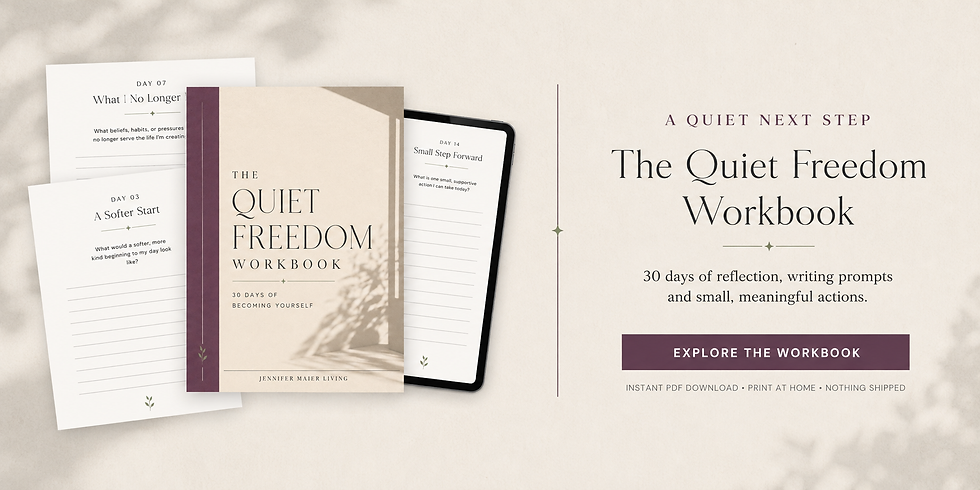
If this recognition feels familiar, The Quiet Freedom Workbook offers a private, guided place to examine the expectations, roles and habits you may have carried for years. It is not about becoming a different person or withdrawing your care from the people you love. It is about understanding what your current way of living is costing you—and deciding, thoughtfully and honestly, what you are no longer willing to carry.
Being the easy one may have made life smoother for everyone around you. But you do not have to wait until burnout tells you that it has become too hard on you.



Comments