When Loss Changes Everything

Grief does not ask you to move on from the person you loved. It asks you to learn how to carry that love into a life you never expected to be living.
There is a moment after a significant loss when the rest of the world appears to resume its usual rhythm. The flowers begin to fade. The phone becomes quieter. Other people return to work, errands, appointments and ordinary conversations. From the outside, life seems to be moving forward. Inside your own life, however, almost nothing feels ordinary. The person who helped make the world recognizable is gone, and you are left trying to understand how everything can look so familiar while feeling completely different.
Grief is often described as sadness, but sadness is only one part of it. Grief can be exhaustion, anger, confusion, guilt, relief, loneliness or fear. It can make you forget why you walked into a room, struggle to follow a conversation or feel overwhelmed by decisions that once seemed simple. It can appear as restlessness when you expected tears or numbness when you thought you would fall apart. There is no single emotional response that proves you loved someone deeply, and there is no correct way to inhabit the days that follow a loss.

When someone dies, we do not lose only the person. We may lose the person who remembered our childhood, understood the family jokes or knew which version of a story was true. We may lose a daily routine, a shared future, a sense of safety or the role we occupied in that relationship. A woman who loses her mother may also lose the person she called when she needed reassurance. Someone who loses a spouse may lose a companion, financial partner, social identity and the person who witnessed the smallest details of her days.
This is one reason grief can feel so disorienting. The loss spreads into places we did not anticipate. It sits in the empty chair, the unopened message thread and the grocery-store aisle where we automatically reach for something they liked. It appears when good news arrives and we realize we cannot tell them, or when something goes wrong and the person we would have called is no longer there.
These secondary losses are not evidence that you are dwelling on the past. They are part of understanding what has changed. Naming them can help explain why certain moments hurt so much and why grief may return long after other people assume the hardest part is over.
Our culture is often uncomfortable with grief that lasts longer than the rituals surrounding it. We know what to do immediately after a death: send food, attend the service, write a note and ask whether anything is needed. We are less certain about the fourth month, the first birthday, the anniversary or the ordinary Tuesday when grief arrives without warning.
The grieving person may feel pressure to appear better before she actually feels better.
She may return to work, answer questions, pay bills and participate in conversations while using nearly all her strength to remain composed. Functioning is not the same as healing. A person can complete her responsibilities and still be carrying an enormous amount of pain.

Healing also does not move in a straight line. You may have several manageable days followed by one that feels almost as difficult as the beginning. A song, scent, photograph or familiar place can reopen the loss with startling intensity. That does not mean you have gone backward. Grief is not a staircase you climb once. It is more like a landscape you gradually learn to navigate, including the places where the ground remains tender.
Loss can become especially complicated when the relationship was difficult, unfinished or different from what other people believed it to be. You may grieve someone you loved deeply and still feel anger about the ways they hurt you. You may mourn the relationship you had, the relationship you hoped to have and the possibility that it might someday have changed.
Relief can also exist beside grief, particularly after a long illness, a demanding caregiving season or a relationship filled with pain. Feeling relieved that suffering has ended—or that a difficult responsibility is over—does not erase love. Human relationships are rarely simple enough to produce only one emotion.
You do not have to rewrite the past to make your grief acceptable. You are allowed to remember what was beautiful and acknowledge what was painful. Honest grief makes room for the whole relationship rather than forcing it into a more comfortable story.
Many people resist the idea of “moving on” because it sounds like abandoning the person who died. They worry that laughing, traveling, changing the house or becoming interested in the future means the loss mattered less. Yet continuing to live is not an act of disloyalty. Love does not disappear because life begins to contain pleasure again.
The relationship changes, but it does not become meaningless. The person you lost may continue through the stories you tell, the traditions you preserve, the qualities you inherited and the ways their love shaped you. You may hear their advice in your thoughts or recognize their expressions in another family member. You may cook their recipes; use something they treasured or notice yourself offering someone else the same kindness they once gave you.

Remembering does not require remaining permanently suspended in the worst moment of your loss. You can carry someone forward without carrying only the pain of losing them.
Grief asks for gentleness, but it also benefits from somewhere to go. Talking with a trusted person, joining a grief-support group, speaking with a counselor or writing privately can help give form to feelings that otherwise seem impossible to hold. The purpose is not to analyze every emotion or force yourself to find a lesson. It is simply to create a place where you do not have to pretend.
Writing can be particularly helpful because grief is often difficult to explain aloud. A page does not become uncomfortable when you repeat yourself. It does not rush to reassure you, compare your loss to someone else’s or suggest that you should be feeling differently. You can write what you miss, what you resent, what you wish you had said and what you are afraid the future will become.
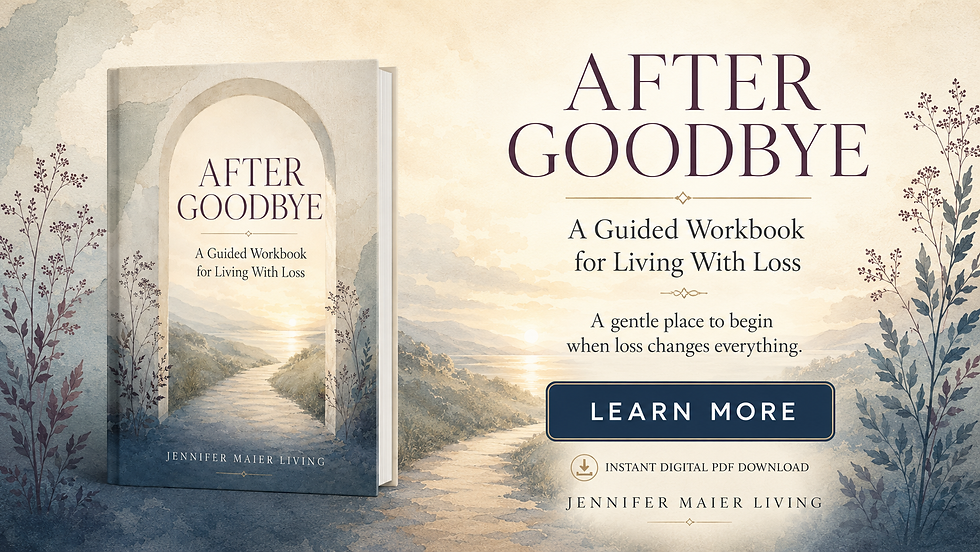
That is why I created After Goodbye. It is a guided grief workbook for the period after the immediate crisis, when the world has grown quieter, but your thoughts may still feel scattered. The prompts help you explore the reality of the loss, the relationship you are grieving, the ways grief lives in your body and daily life, what remains unfinished, and how love and memory may continue to accompany you. It can be printed and written in by hand or downloaded to a tablet and used with a compatible annotation app.
The workbook is not meant to hurry anyone through grief or promise a tidy ending. Some questions may feel helpful immediately, while others may need to wait. You are allowed to skip a page, return later or stop when reflection becomes too much. A workbook can offer structure and companionship, but it is not a substitute for professional mental-health care when additional support is needed.
After goodbye, there is no return to life exactly as it was. There is, however, a gradual process of discovering how to live inside what has changed. You may not stop missing the person you lost, but over time, missing them may no longer occupy every corner of the day. The memories that once brought only pain may begin to bring warmth alongside it. You may find that grief has not erased your capacity for joy, connection or purpose.
You are not required to leave your love behind in order to continue. You are learning to carry it differently, and that, too, is a form of healing.



Comments