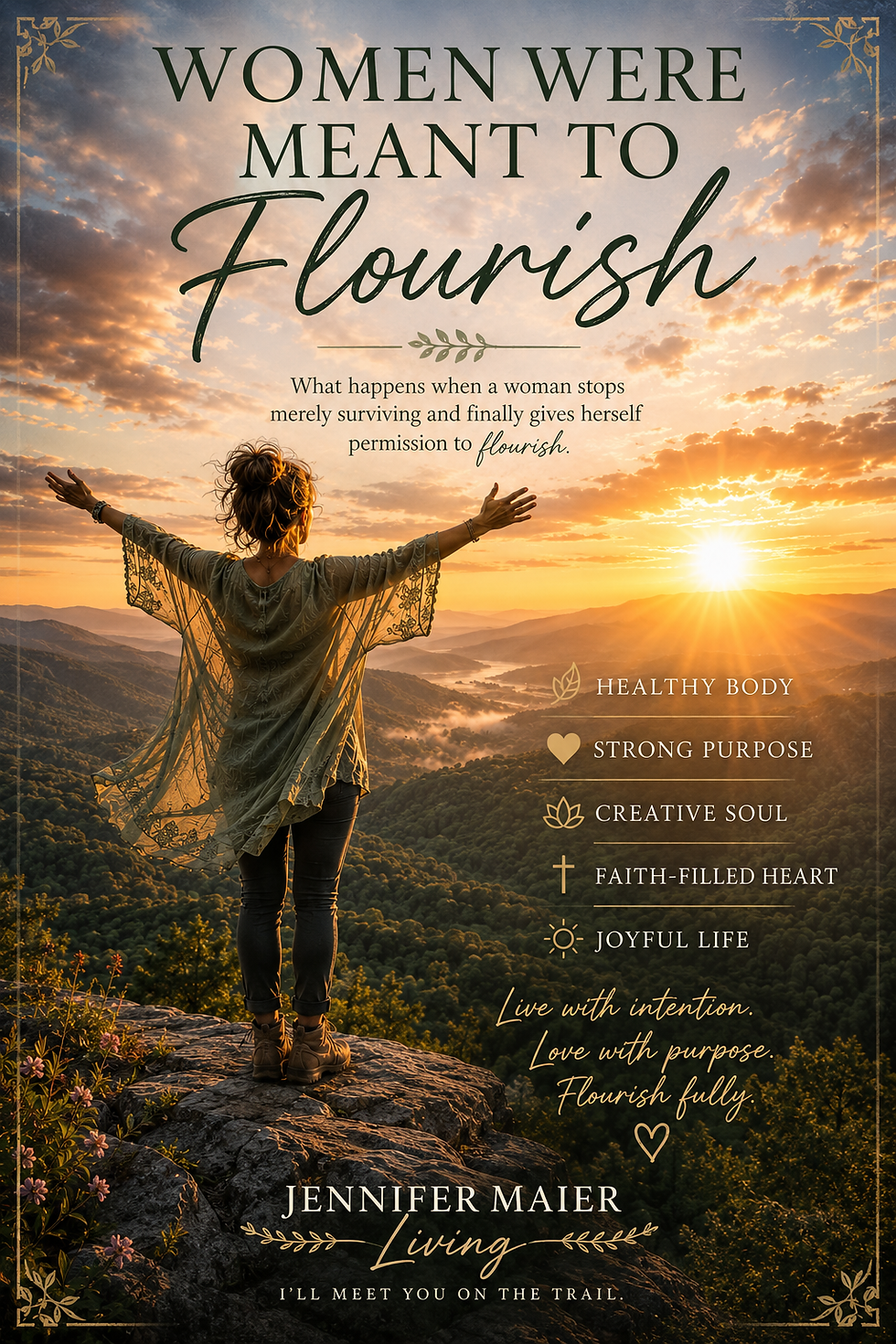
Women Were Meant to Flourish

Updated: Aug 23
What happens when a woman stops merely surviving and finally gives herself permission to flourish.
For much of my life, I thought being a good woman meant being the person everyone could depend on. It meant keeping things moving, remembering what needed to be done, noticing what other people needed before they had to ask, and finding a way to manage whatever landed in front of me.
I took pride in being responsible, capable, and helpful, and I still value those qualities. There is nothing wrong with caring deeply for the people in our lives or taking our responsibilities seriously.
The problem begins when we become so accustomed to giving ourselves away that we no longer recognize how little of ourselves we have left.
I do not remember anyone sitting me down and telling me that my needs should always come last. I think it was something I absorbed slowly, the way many women do. We learn that being accommodating is kind, that saying yes makes us dependable, and that needing rest means we are not trying hard enough. We become skilled at making everyone else comfortable, sometimes without ever asking whether the life we are creating is comfortable—or even sustainable—for us.
For years, I associated strength with endurance. A strong woman kept going. She did not complain. She found a solution. She worked through exhaustion, handled the crisis, showed up for everyone, and worried about herself later. Unfortunately, “later” has a way of never arriving. There is always another responsibility, another deadline, another person who needs something, and another reason to postpone the things that might restore us.
As I have gotten older, I have started questioning that definition of strength. I no longer believe strength is demonstrated only by how much we can carry. Sometimes strength is recognizing that we have carried enough. Sometimes it is setting down a responsibility that never belonged entirely to us. Sometimes it is saying no without writing a five-paragraph apology. Sometimes it is asking for help, admitting that we are tired, or protecting a little space in our lives for something that makes us feel alive.
That realization has led me to think a great deal about the difference between surviving, succeeding, thriving, and flourishing. These words may sound similar, but I do not believe they mean the same thing. Surviving is getting through the day. There are seasons when that is enough, and there should be no shame in it. Success is often measured by what can be seen from the outside: the career, the title, the home, the accomplishments, the full calendar, or the number of people who rely on us. Thriving feels more personal. It means our lives are not only functioning but also nourishing us. Flourishing goes even deeper. It is the experience of becoming more fully ourselves while allowing that fullness to benefit the people and places around us.
I believe women were meant to flourish. We were not created merely to keep everything from falling apart. We were not meant to spend our entire lives maintaining other people’s comfort while quietly abandoning our own dreams. We were not meant to reach the end of every day depleted, only to wake up and repeat the same pattern tomorrow. We were meant to create, contribute, love, learn, grow, rest, laugh, lead, and live with purpose.

That does not mean every day will feel inspiring or that a flourishing life is free from hardship. My own life certainly has not unfolded according to a perfect plan. I have experienced seasons of worry, grief, exhaustion, uncertainty, and physical pain. I recently broke my arm badly enough to require surgery. In one instant, I went from thinking about the things I wanted to accomplish to needing help with some of the simplest parts of daily life. I could not move through my days with the speed or independence I was accustomed to, and I did not enjoy that loss of control.
Yet that interruption also created an unexpected kind of space. My body was forced to slow down, but my mind was full of ideas. I began writing more seriously about my health journey, the lessons I was learning, and the kind of life I wanted to build moving forward. Little by little, Jennifer Maier Living began taking shape. Ironically, the very experience I thought would delay my progress became the beginning of something deeply meaningful to me.
That experience taught me that flourishing does not always begin when circumstances become easier. Sometimes it begins when life disrupts the version of the future we thought we had planned. It can begin in recovery, in uncertainty, or in the uncomfortable realization that we do not want to continue living exactly as we have been living.
Flourishing is not the reward we receive after every problem has been solved. It is a way of choosing to remain open to growth even while life is imperfect.
My work has always mattered to me. As Executive Director of the Shelby County Museum & Archives and in my work with Shelby Iron Works Park, I have been entrusted with preserving history, serving the public, managing responsibilities, solving problems, and creating experiences that connect people with their community. It is meaningful work, and I am proud of it. It can also be consuming because important work rarely arrives in tidy packages. There is always more that could be researched, preserved, repaired, organized, funded, planned, or improved.
Like many women, I know what it feels like to give my work the best of my energy and then come home with very little left for myself. I understand the temptation to believe that personal dreams must wait until the professional responsibilities are finished. The trouble is that meaningful work is never completely finished. There will always be another project, another email, another event, and another need. If we wait until everything is done before allowing ourselves to create, rest, or explore something new, we may wait forever.
I am learning that flourishing professionally does not mean giving my job every part of me. It means bringing my gifts to my work while remembering that I am still a whole person outside of it. My value is not limited to how productive I am or how many problems I can solve in a day. I am also a wife, a writer, a jewelry designer, a woman interested in health and history, a person who loves beautiful objects, and someone who is still discovering new parts of herself at fifty-three.
My jewelry business is one example of that. Creating jewelry allows me to work with my hands, notice beauty, combine unexpected pieces, and turn forgotten objects into something meaningful. There is a different kind of satisfaction in that work. It does not replace my professional life, but it gives another part of me room to breathe. Every time I design a necklace from vintage pearls, an old cross, or a beautiful pendant, I am reminded that creativity is not frivolous. It is one of the ways we understand ourselves.
Writing has become another part of my flourishing. I studied journalism, so words have always mattered to me, but for years writing was something I could easily place behind more urgent responsibilities. Creating Jennifer Maier Living has changed that. Writing these essays gives me a place to think honestly, connect the ordinary moments of my life with the larger lessons they are teaching me, and share what I am learning with women who may be asking similar questions.

The website did not begin because I believed I had all the answers. It began because I realized I had something to share. I am not writing as someone who has reached a perfect destination. I am writing while I am still becoming. I am learning about nutrition, walking, sleep, strength, skincare, resilience, self-respect, faith, and the complicated relationship many of us have with our bodies. I am sharing the process because I believe honesty can create the kind of connection perfection never will.
My health journey has probably taught me more about flourishing than anything else. For many years, I thought becoming healthier was primarily about becoming smaller. I believed that if I could lose enough weight, I would finally feel successful. The scale became the most obvious measure of whether I was doing well, and like many women, I gave that number far too much power.
Losing weight has been important to me, and I am grateful for the progress I have made under my doctor’s care. But somewhere after the first thirty pounds, my questions began to change. I stopped asking only, “How can I lose more weight?” and started asking, “How can I build a life that helps me feel well?” That question led me toward better nourishment, walking, sleep, preventive healthcare, learning about protein, protecting my skin, and eventually thinking about strength and bone health.
The difference may sound subtle, but it has changed the emotional center of my journey. I am no longer trying to punish my body into submission. I am trying to care for it with enough consistency that it can carry me into the years ahead. I want to be strong enough to remain independent. I want the energy to travel, create, work, laugh with friends, and enjoy the ordinary days that make up most of our lives. I want to care for tomorrow’s Jennifer instead of constantly criticizing today’s Jennifer.
That is what thriving has started to mean to me. It is not an impressive before-and-after photograph. It is waking up with more clarity. It is noticing that I have more energy. It is going for a walk and returning with a new idea. It is choosing food because it nourishes me rather than because I am afraid of it. It is protecting my skin because I value the body I have, not because I am ashamed of aging. It is learning to rest before exhaustion makes the decision for me.

Flourishing also means allowing joy to take up space in our lives. Many women are comfortable spending money, time, and energy on things the family needs, but we hesitate when something is simply beautiful or meaningful to us. We can justify the groceries, the school supplies, the repairs, or the gift for someone else. Then we stand in front of a candle, a book, a bouquet of flowers, or a piece of art we love and wonder whether we are being indulgent.
I have become less apologetic about surrounding myself with things that make everyday life feel more beautiful. I do not mean filling a house with endless possessions. In fact, I have become more selective. I would rather own fewer things that I truly love than a great many things I purchased without much thought. A beautiful vase, an old brass frame, a handcrafted tray, a fragrant soap, or a coffee-table book can bring a small sense of pleasure to an ordinary day. Those things are not necessities, but beauty has its own kind of value.
The same is true of comfort. I have written about my affection for kaftans partly because it makes me laugh, but also because they represent something larger. I have spent enough years wearing things that required constant adjustment or made me feel as though my body had to apologize for existing. There is freedom in choosing clothes that feel beautiful and comfortable at the same time. That does not mean I have stopped caring about how I look. It means I have started caring about how I feel too.
Women often hear messages about empowerment that sound like one more assignment. We are told to be stronger, more confident, more productive, more assertive, and more ambitious, as though empowerment requires us to become a new version of the superwoman who was already exhausted. I do not think flourishing should become another standard we fail to meet.
To me, empowerment is not about doing everything. It is about remembering that we have choices. It is the ability to ask whether the life we are living still reflects who we are becoming. It is learning to make decisions from a place of self-respect rather than fear, guilt, or the need for approval. Sometimes an empowered decision is pursuing a promotion. Sometimes it is reducing a responsibility. Sometimes it is beginning a business, returning to school, leaving the party early, scheduling the medical appointment, or spending an afternoon doing something creative.
Flourishing will look different for every woman because we are not all nourished by the same things. One woman may feel most alive building a company. Another may find deep purpose caring for her family. Someone else may discover a talent for painting at sixty-five, return to college at fifty, begin traveling alone, plant a garden, write a book, volunteer in her community, or finally create the peaceful home she has always wanted.
The point is not what she chooses. The point is that the choice belongs to her. A flourishing life is one that feels aligned with her values, gifts, season, and responsibilities. It is not built around constant comparison with women who are living completely different lives.

One of the most important parts of flourishing is learning to set boundaries without believing we are doing something cruel. Boundaries can sound harsh when we first begin using the word, but a healthy boundary is not a punishment. It is an honest statement about what we can give without harming ourselves or becoming resentful.
There was a time when I might have stayed at an event long after I was ready to leave because I did not want anyone to think I was rude. Today, if I have enjoyed myself and I am tired, I am far more likely to thank the hostess and go home. That may appear to be a very small act, but it represents a meaningful shift. I no longer believe every decision has to be approved by an invisible committee before I am allowed to honor my own needs.
Boundaries can be as simple as not answering every message immediately, protecting time for a walk, declining a commitment that would leave us overwhelmed, or telling someone kindly that we cannot take on another responsibility. They can also involve asking the people in our homes to share the work that keeps those homes functioning. A loving relationship should have room for both people’s needs, goals, fatigue, and dreams.
This is where the idea of empowerment over sacrifice becomes especially important. Love will always involve giving. Families require compromise, care, patience, and occasionally doing things we would not have chosen for ourselves. That is part of loving other people. But love should not require one person to disappear.
Constant sacrifice may look generous from the outside, but it can eventually produce exhaustion and resentment. When we never speak honestly about what we need, the people around us may not even understand what is being asked of us. They simply become accustomed to the arrangement. Speaking up gives relationships an opportunity to become more balanced, honest, and reciprocal.
Women sometimes worry that prioritizing themselves will make them less loving. I have come to believe the opposite is often true. When we are rested, nourished, creative, and emotionally well, we have more genuine love to offer. We can be present instead of merely performing the tasks associated with care. We can give because we choose to, not because guilt has backed us into a corner.
There is also a professional side to flourishing. Many women are excellent at doing the work but uncomfortable asking for recognition, compensation, support, or opportunity. We wait to be noticed. We assume our dedication will speak for itself. Sometimes it does, but sometimes self-advocacy is necessary.
Self-advocacy does not require becoming aggressive or pretending to be someone we are not. It can sound like clearly explaining the value of our work, asking for the resources needed to succeed, applying for an opportunity before we feel perfectly qualified, or refusing to minimize an achievement so other people will feel more comfortable. It can mean allowing ourselves to say, “I worked hard for this,” without immediately following it with an apology.

At the same time, thriving at work is not always about climbing higher. Sometimes it is about creating better alignment between our professional life and our personal values. Success that destroys our health, relationships, peace, and sense of self may not feel like success for very long. Flourishing asks us to consider not only what we are accomplishing but also what those accomplishments are costing us.
That question can be uncomfortable because many of us have built identities around being the capable one. If we stop doing everything, we may worry that people will no longer value us. We may even wonder who we are without the constant stream of responsibilities that has defined us for years.
This is why self-awareness matters. Before we can build a life that nourishes us, we have to notice what is draining us. We need to become curious about our own patterns. Where do we say yes while silently hoping someone will give us permission to say no? Which responsibilities genuinely matter to us, and which ones have we continued out of habit? What parts of ourselves have been waiting quietly because we always promised we would get to them later?
These questions do not require dramatic answers. We do not need to resign from our jobs, rearrange our families, or reinvent our lives by next Monday. Most flourishing begins much more quietly than that. It begins with one honest decision.
It may begin with scheduling the appointment we have postponed, taking a thirty-minute walk, joining a class, picking up a book, asking for help, returning to an old hobby, or creating an hour each week that belongs to us. It may begin with turning off our phones, going to bed earlier, applying for the position, opening the savings account, or finally telling someone how overwhelmed we have become.
Small decisions are not insignificant. My own life has changed through a collection of very ordinary choices. Drinking more water, taking walks, learning about nutrition, paying attention to sleep, writing down an idea before I forgot it, buying a domain name, publishing the first essay, and continuing even when I did not know exactly where it was leading have all become part of a much larger transformation.
None of those choices looked revolutionary when I made them. That is one of the reasons we underestimate them. We are waiting for the dramatic moment when everything changes, while our lives are being shaped by the small things we repeat every day.
A woman begins to flourish when she stops treating her own well-being as an optional extra. She begins to flourish when she recognizes that rest is not a reward she must earn by reaching complete exhaustion. She begins to flourish when she gives her creativity somewhere to go, her body the care it needs, her voice the right to be heard, and her dreams a place on the calendar.
She also begins to flourish when she stops expecting herself to do it all alone. Supportive relationships matter. We need people who celebrate our growth rather than feeling threatened by it. We need friends who can listen without turning every conversation back toward themselves. We need partners who understand that love is not measured by how much one person gives up. We need mentors, physicians, therapists, teachers, coaches, faith communities, or other forms of support when those resources are appropriate for our lives.

Asking for help is not an admission that we are incapable. It is a recognition that human beings were never meant to carry everything alone. Some of the strongest women I know are strong because they have learned when to reach for another hand.
Flourishing also has a spiritual dimension for me. My faith reminds me that my life has purpose beyond achievement. I do not believe God measures my value by the number of tasks I complete, the size of my body, the perfection of my home, or how well I hide my exhaustion. I believe I am called to be a good steward of the life and gifts I have been given.
Stewardship does not mean neglecting ourselves for everyone else. It means caring responsibly for our bodies, minds, relationships, talents, time, and opportunities. It means recognizing that our gifts are meant to be used, not buried beneath an endless list of reasons why someone else’s needs must always come first.
I think many women reach a certain age and realize that they have spent decades becoming who everyone needed them to be. They have been daughters, wives, mothers, employees, leaders, caregivers, organizers, peacemakers, and problem-solvers. Then one day, perhaps in a quiet house or on a solitary walk, another question rises to the surface: Who am I now?
That question is not a crisis. It may be an invitation.
Midlife is often discussed as though it is primarily a season of loss. We hear about changing bodies, aging skin, empty nests, shifting careers, and the passage of time. Those changes are real, and some of them carry grief. But there is another side to this season that deserves just as much attention. We know ourselves better. We understand that time is valuable. We become less willing to spend it performing a life that does not feel honest.
At fifty-three, I am not trying to become the woman I was at thirty. I want to become the healthiest, strongest, most peaceful, creative, faithful, and authentic version of the woman I am now. That does not require rejecting my past. Everything I have lived through has brought me here. It simply means allowing what comes next to be shaped by wisdom instead of fear.
I want to keep walking, writing, creating jewelry, learning, preserving history, caring for my health, and building Jennifer Maier Living into something meaningful. I want to protect my peace without closing my heart. I want to love the people in my life generously without disappearing inside their expectations. I want to work with purpose and still leave enough room to enjoy the life my work is supposed to support.
That is what flourishing looks like to me right now. It may look different in five years, and that is perfectly all right. Flourishing is not a permanent state we finally achieve. It is an ongoing willingness to pay attention to what helps us feel alive, grounded, useful, connected, and true to ourselves.
Perhaps you are reading this while feeling very far from that kind of life. Maybe you are exhausted. Maybe you have spent so long taking care of everyone else that you do not even know what you want anymore. Maybe the dreams you once had feel unrealistic now, or perhaps you feel guilty for wanting something that belongs only to you.
I hope you will begin by offering yourself compassion rather than criticism. You did not arrive here because you were weak. You may have spent years responding to real responsibilities, loving people deeply, and doing the best you could with what you knew. This is not about condemning the woman who survived. It is about thanking her for getting you this far and allowing her to become something more.
You do not have to transform your entire life today. Start by noticing what gives you energy and what consistently takes it away. Pay attention to the moments when you feel most like yourself. Ask what you have been postponing and whether it truly needs to wait. Create one small boundary. Protect one hour. Make one appointment. Have one honest conversation. Take one step toward something that matters to you.
Flourishing is built through those steps. It grows when a woman begins believing that her needs matter, her voice matters, her work matters, her health matters, her joy matters, and her dreams are not foolish simply because they arrived later than she expected.
We have spent enough time admiring women for how much they can endure. I would like us to start celebrating how fully they can live.
A flourishing woman is not selfish. She is awake to her own life. She knows that caring for herself helps her care more honestly for others. She understands that rest and ambition can coexist, that strength and tenderness belong together, and that love should make room for both generosity and self-respect.
She does not have to become louder, harder, busier, or more impressive. She simply has to become more fully herself.
That is the woman I am still becoming, and perhaps you are becoming her too.
Women were never meant only to survive their lives. We were meant to inhabit them fully, use our gifts courageously, care for ourselves faithfully, love others without abandoning ourselves, and leave the people and places around us better because we were here.
We were meant to flourish.
Jennifer
Comments