The Art of the Slow Morning

Updated: Aug 23
What I stopped doing before 9 a.m.—and what I started doing instead.
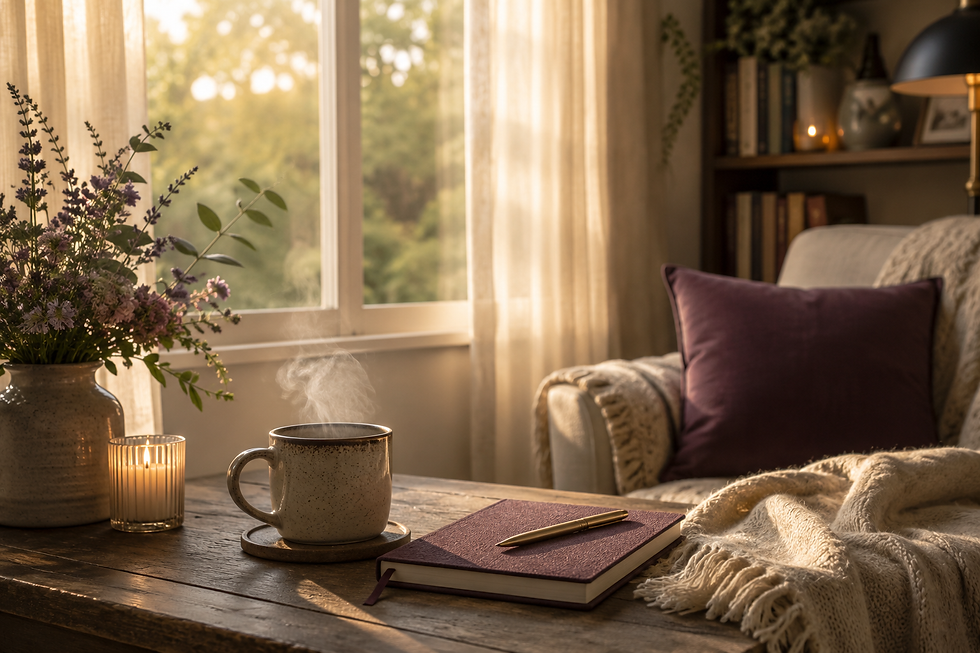
Stop Giving the World the First Word
For years, I don't think I ever really considered who—or what—got the first few minutes of my day. I simply woke up and reached for my phone. It was such an automatic movement that I'm not sure I could have told you when the habit started. Before I had fully opened my eyes, I could know who had emailed me, what had happened overnight, whether someone had texted, what the weather was going to do, and what people I barely knew had eaten for dinner the night before. All of that information arrived before I'd even had the opportunity to hear my own thoughts.
And there is always something waiting for us on that little screen. An email that needs an answer. A headline designed to make us worried. A notification reminding us about something we've forgotten. A text that changes the plans we thought we had for the day. Even perfectly pleasant things can pull us somewhere else. I can open Pinterest intending to look at one photograph and, forty-five minutes later, find myself watching a woman organize a refrigerator I've never seen in a house I'll never visit. Somehow I now know exactly how she stores her blueberries, and I still haven't made my coffee.
I'm not interested in declaring phones the enemy. I love mine. It helps me write, research, take photographs, stay connected to people I care about, find directions when I have absolutely no idea where I'm going, and answer questions that would once have required an encyclopedia. Technology has made parts of our lives enormously easier. But convenience has a way of quietly becoming access, and somewhere along the way we began giving the entire world permission to walk into our bedrooms before our feet had even touched the floor.
That is the part I've started questioning.
Those first few minutes after waking have a softness to them that disappears remarkably quickly. The house may still be quiet. The light is different. The responsibilities of the day exist, of course, but for a brief moment they haven't fully arrived yet. There is a little space between sleep and everything that comes next, and I've begun to think that space is worth protecting.
I don't mean creating some rigid rule that the phone must remain locked in a drawer until precisely 8:00 a.m. That would simply turn slowing down into another assignment. What I'm talking about is much smaller. Maybe the phone waits until after the coffee is made. Maybe it stays on the nightstand while you open the curtains and let the dog outside. Maybe you give yourself fifteen minutes to sit, pray, read something, stretch, or simply stare out the window while your brain catches up with the fact that another day has begun.
Fifteen minutes doesn't sound like much, but think about the difference between beginning your morning with your own thoughts and beginning it with everyone else's.

When I reach for my phone immediately, I become reactive almost before I'm awake. Someone else's question becomes something I need to solve. Someone else's plans enter mine. A news story gives me something to worry about. An email reminds me of work that needs to be done. Without consciously choosing it, my attention has already left the room.
But when I allow even a little quiet before all of that begins, the morning feels different. Nothing dramatic happens. I don't suddenly become more enlightened, and birds certainly don't gather outside my window to celebrate my personal growth. I simply have a chance to arrive in my own day before everyone else does.
I think that's what we're really protecting when we talk about slower mornings: our attention. We tend to think of time as our most precious resource, but attention may be just as valuable. We can technically have an hour to ourselves and still spend the entire hour mentally somewhere else. We can drink coffee without tasting it, sit beside someone without really listening, walk through a beautiful morning while staring at a screen, or read three pages of a book and realize we haven't absorbed a word.
Where our attention goes, a piece of our life goes with it.
There will be plenty of opportunities throughout the day to answer emails, read the news, check messages, look at Pinterest, and find out what everyone else is doing. The world is remarkably good at finding us. We don't have to worry that it will forget.
Maybe we can let it wait just a little while.
Not because we're trying to become more disciplined. Not because delaying our phones is another habit we need to master. And certainly not because there is anything morally superior about drinking coffee without checking email.
Simply because the world doesn't always have to get the first word.
Some mornings, perhaps we should.
MORE ON SLOWING DOWN → If this way of living speaks to you, read my essay about learning to stop rushing through the ordinary parts of life.
Make the First Cup Count
There is something almost ceremonial about the first cup of coffee in the morning, even when we don't treat it that way. The sound of it brewing, the smell filling the kitchen, the warmth of the mug in your hands before the rest of the day has fully arrived—these are such ordinary things that we barely notice them anymore. But I've started to think that the first cup can be a tiny anchor for the morning, a few minutes when nothing particularly important is happening and that is precisely what makes it important.
For years, I was much more likely to carry my coffee around than actually sit down and drink it. I would pour a cup and immediately start doing something else—straightening the kitchen, checking a message, looking for something I'd misplaced, starting a load of laundry. I'd walk from room to room with the mug in my hand, taking a sip whenever I happened to remember it was there. By the time I finally slowed down enough to pay attention, the coffee was lukewarm and the morning had already moved on without me. It seems like such a small thing, but I think it says a lot about the way many of us have learned to live.
We are constantly consuming things we supposedly enjoy while simultaneously doing something else. We drink coffee while answering email, eat lunch while scrolling, listen to a podcast while folding clothes, and watch television while looking at our phones. Even pleasure has become something we multitask our way through. We are technically doing all the things we enjoy, but sometimes I wonder how much of them we're actually experiencing.
Lately, I've been trying to let the first cup of coffee simply be the first cup of coffee. It doesn't need to be a productivity tool or fuel I gulp down before starting the day. I like pouring it into a mug I genuinely enjoy using and sitting somewhere for a few minutes before deciding what needs my attention next. Sometimes I look out the window. Sometimes I read. Sometimes I think about the day ahead without making a list or turning those few minutes into a planning session. And sometimes I simply sit there and enjoy the fact that the house is quiet.
Nothing about my life changes dramatically because I sat down with my coffee. The responsibilities waiting for me are still there. The emails haven't answered themselves, the laundry remains remarkably committed to reproducing, and whatever is on my calendar still expects me to show up. The difference is that I've actually experienced those few minutes instead of rushing through them. I think this is part of what slow living means in practice. It isn't necessarily about removing things from our lives or moving through the entire day at some dreamy, leisurely pace. Sometimes it is simply about being fully present for the things that are already there.
I've also come to appreciate the small objects that turn an everyday routine into something that feels a little more intentional. A favorite mug, a pretty coaster, a linen napkin, a little tray, or even the spoon you always reach for can make an ordinary Tuesday morning feel cared for. None of these things is necessary, of course, and I think that's part of their charm. I've spent enough years believing that the beautiful things should be saved for company, holidays, or special occasions. These days, I'm much more interested in using them while I'm actually living my life.
I used to think those little touches were frivolous. Now I think they are part of the way we make a home—and a life—feel like our own. We don't need a prettier coffee cup to have a meaningful morning, but we are allowed to enjoy the objects and rituals that make ordinary life feel good. Not every pleasure needs to justify itself by being useful. Sometimes a beautiful mug is simply a beautiful mug, and sometimes drinking coffee from it while the morning light comes through the window is reason enough to use it.
Perhaps that's what I'm learning to appreciate most about slower mornings. They bring me back to my senses before my schedule takes over: the warmth of the mug, the smell of coffee, the changing light through the window, the quiet of a house that hasn't quite gotten started yet. These moments are almost embarrassingly simple, which may be why we overlook them. We keep waiting for life to give us larger moments worth noticing while dozens of smaller ones quietly pass through our hands every day.
So one of the changes I've made to my mornings is almost laughably uncomplicated: whenever I can, I sit down for the first cup. I don't always manage it. There are mornings when appointments are waiting, work needs attention, or my to-do list seems to have gotten up long before I did. But when the morning allows it, I let the coffee stay hot, I let the chair be comfortable, and I let whatever comes next wait for a few minutes. Sometimes slowing down doesn't require reorganizing your entire life. Sometimes it begins with finally sitting down long enough to enjoy the coffee you already made.

Create Somewhere You Actually Want to Sit
I've started to believe that our homes quietly teach us how to use our time. A kitchen counter covered with mail reminds us there are things to deal with. A desk with an open laptop seems to whisper that we could probably answer one more email. Even the sofa can become less a place to rest and more the place where we collapse at the end of the day, turn on the television, pick up our phones, and somehow manage to consume two different forms of entertainment without paying much attention to either one. Our surroundings give us cues all day long, whether we realize it or not.
That's one reason I think having somewhere you genuinely want to sit can make such a difference to a slower morning. It doesn't have to be an entire room, and it certainly doesn't need to look like something from a decorating magazine. It might be one chair beside a bedroom window, the comfortable end of the sofa, a little spot in the sunroom, or a forgotten corner that you've never quite known what to do with. What matters isn't the square footage. It's that when you see that place, something about it says, You can stay here for a while.
I think many of us have become very good at creating spaces for everything we're expected to do. We have places to work, cook, wash clothes, get dressed, pay bills, store things, and charge devices. Yet it can feel surprisingly indulgent to claim a few feet of our own homes for something with no obvious productive purpose. A chair for drinking coffee. A lamp for reading. A small table with enough room for a book and a mug. A throw within reach on a chilly morning. None of it accomplishes anything, at least not in the traditional sense, and perhaps that's exactly why it matters.
I recently spent quite a bit of time thinking about this while writing about creating a reading nook, and I kept coming back to the same idea: maybe what we're missing isn't always more time. Maybe sometimes we're missing a place that reminds us what we want to do with the time we already have. When there is a chair waiting beside the window and a book sitting within reach, reading for fifteen minutes suddenly feels easier. When there is somewhere pleasant to drink coffee, we're more likely to sit down instead of wandering around the house with the mug in one hand and a laundry basket in the other. The environment gives us permission before we've even consciously asked for it.
There is also something deeply personal about creating a corner like this. It doesn't need to coordinate perfectly with the rest of the house, and it doesn't have to satisfy anyone else's idea of good design. In fact, I think the best spaces contain things that make sense primarily to the person who uses them. Maybe it's an old chair you've had for years because it happens to fit your body perfectly. Maybe it's a small table you found in an antique shop, a pillow in a pattern you love, a stack of books that never seems to get smaller, or a photograph that makes you happy every time you notice it. The goal isn't to create a showroom. It's to create somewhere that feels like an invitation.
And once you have that place, something interesting happens: you begin using it differently because you've given it a purpose. You stop seeing an unused corner and start seeing your morning chair. You begin leaving the book you're reading there. Your glasses find their way to the little table. Perhaps there's a coaster waiting for your coffee or a basket nearby with a throw tucked inside. Slowly, the space begins gathering the little things that make staying there easier, and what once seemed like an ordinary corner becomes part of a ritual.
That's really what I'm after with a slow morning. I'm not trying to construct a beautiful fantasy in which every day begins with two uninterrupted hours of reading beside a perfectly styled window. Most mornings won't look like that. But I do think our homes can help us remember the kind of life we want to live. A comfortable chair can remind us to sit. A book can remind us to read. Morning light can remind us to look up. And a little corner that asks absolutely nothing of us can remind us that we don't have to be accomplishing something every minute we're awake.
Sometimes creating a slower life begins not by finding another hour in the day, but by making one small place in our homes where we're willing to spend the minutes we already have.
CREATE A PLACE FOR IT → What if your home had one little corner that asked absolutely nothing of you? I recently wrote about creating a reading nook designed for reading, resting, morning coffee, and the ordinary moments we so often rush past.
Read Something Before You Scroll Something
There is a very different feeling between beginning the morning by reading something and beginning it by scrolling through something. Both involve words on a page or screen, but they ask entirely different things of our attention. Scrolling encourages us to keep moving. One headline leads to another, one photograph becomes another, and before long we've absorbed dozens of disconnected pieces of information without spending very much time with any of them. Reading asks us to stay. It gives our minds somewhere to settle for a little while, which may be exactly what we need before the rest of the day begins pulling our attention in a dozen different directions.
I'm not suggesting that every morning needs to begin with serious literature and a dictionary nearby. Reading can be wonderfully undemanding. It might be ten pages of the novel you didn't want to put down the night before, a few paragraphs from a devotional, a passage from the Bible, a poem, an essay, or even an article in a magazine you have been meaning to read. Some mornings I might want something that makes me think. Other mornings, I simply want something enjoyable. The point isn't really what we read. It's the decision to give our attention to one thing instead of immediately scattering it among everything waiting for us online.

I've become especially fond of the idea of a daily reader for this reason. There is something wonderfully manageable about a book that asks for only one short reading each day. One I've been drawn to is Around the Year with Emmet Fox, a collection of 365 daily meditations centered on spiritual reflection, resilience, and the power of our thoughts. I like the simplicity of opening to that day's reading and knowing I don't have to get anywhere beyond it. Sometimes a few paragraphs are enough to give me something to carry into the rest of the day. A daily devotional or a few verses of Scripture can serve the same purpose. The goal isn't to race through a book; it's to begin the morning with something that helps us turn inward before everything else asks us to turn outward.
And then there are mornings when I want to disappear into a story instead. I will probably always love physical books—the feel of the pages, the weight of the book in my hands, the satisfaction of sliding a bookmark between the pages when I stop—but I also appreciate the convenience of a Kindle. Having an entire library within reach means I can read whatever suits the morning without getting up to hunt for another book. I don't see one replacing the other. Some books I want to hold, underline, stack on a table, and keep forever. Others I am perfectly happy carrying around in a device that weighs less than a paperback. What matters is that the reading happens.
The important thing for me is not to turn this into another morning achievement. I don't need to finish a chapter before I'm allowed to consider the reading worthwhile. Five pages count. One page counts. A paragraph that makes me stop and think counts. We have become remarkably talented at taking pleasurable things and turning them into measurable goals—books per year, pages per day, reading streaks, challenges completed—and there is nothing wrong with enjoying those things if they motivate you. But there is also nothing wrong with reading simply because you like to read.
That may be the greatest difference between reading and scrolling in the morning. When I scroll, I rarely reach a natural stopping point. There is always another post, another headline, another photograph, another little piece of information waiting below the one I'm looking at. A book allows me to stop. I can reach the end of a page, close it, take another sip of coffee, and sit quietly for a moment with whatever I've just read. My attention hasn't been pulled in fifty directions. It has been allowed to rest in one place.
I'm not giving up my phone, and I'm certainly not pretending I never scroll in the morning. Some days I do. But I'm becoming more conscious of the difference between starting the day by consuming whatever an algorithm decides to put in front of me and choosing something I actually want to give my attention to.
Perhaps that's another small way of reclaiming the morning. Before we find out what everyone else has posted, purchased, argued about, cooked, renovated, or accomplished overnight, we can spend a few minutes with words we deliberately chose for ourselves.
Sometimes the most peaceful thing we can do before the day gets noisy is simply open a book and let our minds stay in one place for a while.
Put Something on Paper
There is something different about writing by hand. I spend plenty of time typing, and I certainly appreciate how quickly my fingers can move across a keyboard when my thoughts are coming faster than I can organize them. But a pen and a piece of paper seem to ask me to slow down. I can't write as quickly as I can type, and perhaps that's part of the point. The words have to wait their turn. I have a little more time to consider what I'm actually trying to say before the next sentence appears.
That's why I like the idea of keeping a journal or notebook somewhere near the place where I spend those quieter morning minutes. Not because I believe everyone needs to begin the day writing three pages about her innermost thoughts, and certainly not because I want journaling to become another requirement on the perfect-morning checklist. Some mornings I may have absolutely nothing profound to say. That's fine. A notebook doesn't have to contain revelations to be worthwhile. It can hold a thought I don't want to forget, something I'm grateful for, a prayer, a line from the book I'm reading, something that's worrying me, or an idea that arrived while I was drinking my coffee.
Sometimes simply putting a worry on paper changes it. The problem may still be there, but it no longer has to circle endlessly in my head while I'm trying to think about everything else. I can write down what I'm concerned about, what I can do about it, or perhaps admit that there is nothing I can do about it today. Other mornings, writing might be as simple as recording something good that happened the day before. Not because I'm forcing myself to practice gratitude correctly, but because good things can be remarkably easy to forget when difficult things are making more noise.

Prayer can find its way onto the page too. There are times when writing a prayer helps me say what I haven't quite been able to put into words otherwise. It slows me down enough to recognize what I'm asking for, what I'm afraid of, what I'm thankful for, or what I need to release. I don't think there is a correct format for any of this. The notebook isn't being graded, and no one else ever has to read it. That privacy may be one of the reasons writing by hand can feel so freeing.
I've also noticed that the act itself has become increasingly appealing to me—the notebook, the paper, a pen that feels good in my hand, the little pause before I begin. In a world where so much of what we create disappears into screens, there is something wonderfully tangible about handwriting. The letters aren't perfectly uniform. Something gets crossed out. A thought wanders into the margin. The page begins to look like evidence that an actual person was there thinking about something.
Perhaps that's also why I've found myself drawn again to the lost art of writing letters. There is a kind of attention involved in putting words onto paper for another person that feels different from sending a quick text or email. You sit down. You think about what you want to say. You choose the words, write them in your own hand, fold the paper, and send something physical out into the world. The slowness is not an inconvenience; it is part of what gives the gesture meaning.
A LITTLE MORE ANALOG LIVING →If you've ever missed the pleasure of receiving something handwritten in the mail, I wrote about why I think putting pen to paper still matters.
I don't expect to write a letter every morning, of course. Most days, a few lines in a notebook are more realistic. What matters is creating a small opportunity to hear my own thoughts before the day becomes crowded with everyone else's. Just as reading gives my attention somewhere to settle, writing gives my thoughts somewhere to land.
And there is no required length. One page is enough. Three sentences are enough. Sometimes a single line is enough. The goal isn't to become a more disciplined journal keeper or accumulate shelves of beautifully filled notebooks. The goal is simply to make a little room for reflection before moving into the busier part of the day.
Some mornings the page may hold something meaningful. Other mornings it may contain a grocery reminder, a book quote, a prayer, and a note that I need to buy toothpaste. That's real life, and I rather like it that way. A slow morning doesn't need to produce wisdom to be worthwhile.
Sometimes it is enough to sit with a cup of coffee, pick up a pen, and give yourself a few quiet minutes to discover what was already on your mind.
Don't Let a Number Decide What Kind of Morning You're Going to Have
There are so many numbers waiting to tell us something about ourselves before we've even had breakfast. The bathroom scale has a number. The watch on our wrist has a sleep score, a step count, and perhaps an opinion about whether we recovered properly overnight. Our phones can tell us how many hours we slept, how many notifications are waiting, how many people visited something we posted, and how much money is sitting in the bank account. We have become extraordinarily good at measuring our lives, and I sometimes wonder whether we've become equally good at allowing those measurements to tell us how we're supposed to feel about them.
The bathroom scale has been one of the biggest examples of this for me. I know what it's like to wake up feeling good about the choices I made the day before, step onto the scale expecting confirmation, and watch my entire mood change when the number isn't what I hoped to see. Suddenly, the walk doesn't seem to count. The nourishing food doesn't seem to matter. The water, the sleep, the consistency, and all the quiet decisions that made yesterday a good day can disappear beneath one disappointing number. Nothing about the previous day has actually changed, but within seconds I've changed the story I'm telling myself about it.

I've had to learn that information and judgment are not the same thing. A scale can tell me what my body weighs at that particular moment. It cannot tell me whether yesterday was successful. It cannot measure whether I'm becoming stronger, whether my habits are improving, whether my clothes fit differently, or whether I'm learning to take better care of myself. It certainly cannot determine whether I deserve to feel proud of the effort I'm making. Yet if I'm not careful, I can give that little piece of bathroom equipment enough authority to determine the emotional temperature of my entire morning.
And the scale isn't the only number capable of doing this. Maybe you wake up and immediately check your sleep score, only to discover that your watch has decided you slept terribly even though you felt perfectly fine until it told you otherwise. Perhaps you open an email and see a financial number that makes your stomach tighten. Maybe you check social media and discover that something you worked hard on didn't receive the response you hoped for. Numbers can be useful. They can help us recognize patterns, make decisions, and understand what's happening. But useful information doesn't automatically deserve control over our mood.
That's something I explored much more deeply in The Scale Has a Mean Streak. I had to learn that body weight can fluctuate for all kinds of ordinary reasons—water, sodium, digestion, hormones, exercise, sleep, stress—and that one morning's number is incapable of telling the entire story of what is happening in a living body. More importantly, I had to recognize how quickly I was turning information into a verdict. The scale wasn't necessarily being cruel to me. I was allowing a number to say things about me that the number itself had never actually said.
WHEN THE SCALE GETS THE FIRST WORD → If you've ever done everything “right” and still watched the number go in the wrong direction, I wrote about why the scale can change when nothing has gone wrong—and why it doesn't get to decide whether you're making progress.
This doesn't mean I'm going to throw away every measuring device I own or stop paying attention to information that can genuinely help me. I still believe in tracking progress. I like knowing whether I'm moving in the direction I want to go. But there is a difference between checking a number and handing that number responsibility for the way I feel about myself. Increasingly, I'm learning that some information can wait until I've had a chance to become a person first.
Maybe I drink the coffee before I step onto the scale. Maybe I decide how I feel before asking my watch how well it thinks I slept. Maybe I don't check website statistics, email, or anything else capable of producing an immediate emotional reaction during the first quiet minutes of the morning. The numbers will still be there later. They aren't going anywhere.
I don't want the first thing I learn about myself every morning to be a measurement. I want to know whether the sun is coming through the window, whether the coffee tastes good, whether I slept comfortably, what I'm thinking about, what I'm grateful for, and perhaps what I need from the day ahead. Those things may not fit neatly into a dashboard, but they are information too.
A slower morning gives me a little room between waking up and evaluating myself. It reminds me that I existed before the number appeared and that I will continue existing after it disappears from the screen. Whatever the scale, watch, phone, or dashboard eventually tells me can be considered in context rather than received as a verdict.
There will be plenty of numbers throughout the day. Some will make me happy. Others won't. But I'm becoming much more selective about which ones are allowed to speak first.
Because sometimes protecting the morning means deciding that not everything that can be measured needs to be measured before coffee.
Step Outside Before the Day Gets Loud
There is something different about the world early in the morning. Even familiar places seem softer before the day fully gets underway. The air feels different. The light is gentler. The neighborhood hasn't quite reached its normal volume, and for a little while, even places that will soon be filled with cars, lawn mowers, deliveries, conversations, and all the other sounds of daily life seem almost peaceful. I think that's one of the reasons I've come to appreciate being outside in the morning so much. It gives me a chance to experience the world before everything—including me—starts moving quite so fast.
Walking has become an important part of my life, but I'm increasingly aware that not every walk needs to be treated like exercise. There are certainly days when I pay attention to distance, pace, steps, and whether I've closed a ring on my watch. I have goals, and movement matters to me. But some of my favorite walks are the ones when I stop thinking about what the walk is accomplishing and simply notice where I am. The temperature of the air. Birds making far more noise than seems reasonable for creatures that small. Someone's flowers blooming beside the sidewalk. The smell of freshly cut grass. The way sunlight moves through the trees as the morning changes. Those things have absolutely nothing to do with calories burned, which may be precisely why they matter.
For years, I think many of us learned to see movement primarily as something we did to change our bodies. We walked to burn calories. We exercised to lose weight. We measured whether the effort was worthwhile by what it eventually did to the number on the scale. There is nothing wrong with wanting those benefits, and walking can certainly be part of becoming healthier. But when movement exists only as a form of correction—something we do because we ate too much, weigh too much, or believe our bodies need fixing—we miss much of what it can give us.
A quiet morning walk can clear my head in a way sitting inside sometimes can't. Thoughts that felt tangled begin sorting themselves out somewhere along the road. A problem I've been turning over in my mind may look different after twenty minutes outside. Sometimes I think about something I'm writing. Sometimes I pray. Sometimes I listen to something. And sometimes I don't do anything except walk and notice what is happening around me. There is a kind of freedom in movement that isn't being performed, measured, or used as punishment.

Morning light has its own value too. Stepping outside reminds the body that the day has begun in a way that staring at a bright phone screen never quite does. But even without turning the experience into another health prescription, there is something grounding about seeing the actual sky. You know whether it's cloudy because you looked up, not because an icon on your phone told you. You know whether the air is cool because you felt it. You notice that the season is beginning to change because the light looks different or the leaves aren't quite the same color they were last week.
That kind of noticing is at the heart of slow living for me. Slowing down doesn't always mean sitting still. Sometimes it means moving slowly enough through the world that we actually see it.
WHY I KEEP WALKING →Walking began as part of my health journey, but it has become something much bigger. I wrote more about why one of the simplest forms of movement may also be one of the most overlooked.
You don't need an elaborate morning walking routine to experience this. You don't need special mileage, an impressive pace, or a goal that turns the walk into another obligation. Maybe it's ten minutes around the block. Maybe it's walking the dog without simultaneously checking your phone.
Maybe it's taking your coffee onto the porch and simply standing outside for a few minutes. The point isn't how far you go. The point is stepping into the actual morning before becoming completely absorbed in the day waiting for you.
There will be plenty of time later for schedules, screens, errands, appointments, and all the things that make a day feel full. But early in the morning, before everything gets loud, there is sometimes a small window when the world feels as though it belongs to no one in particular.
I've come to love meeting it there.
Take Care of Yourself Before You Correct Yourself
I think there is a subtle difference between taking care of ourselves and trying to correct ourselves, although for much of my life I probably treated the two as if they were the same thing. So many of the routines women are encouraged to follow begin with the assumption that something needs fixing. We need to lose the weight, cover the gray, erase the lines, brighten the skin, flatten something, tighten something else, become more energetic, more polished, and somehow emerge each morning looking as though aging has been happening to everyone except us.
There is nothing wrong with wanting to look good. I still care about my skin. I enjoy makeup. I like clothes that make me feel good when I put them on, and I certainly haven't reached some enlightened stage where I look in the mirror every morning and adore absolutely everything I see. But the older I get, the more interested I am in asking a different question. Instead of beginning with What needs fixing today?, I am learning to ask, What needs caring for today? Those questions may sound similar, but they feel completely different.
That change shows up in very ordinary morning routines. Washing my face and applying skincare can be about protecting the skin I have rather than trying to erase every piece of evidence that I've lived in it. Taking medications or supplements can be an act of caring for the body carrying me through the day. Brushing my hair, putting on something comfortable, making the bed, or taking a few extra minutes to moisturize aren't necessarily attempts to transform myself into someone more acceptable. They can simply be ways of treating myself as though I'm worth looking after.
I especially notice this difference when it comes to skincare. For years, beauty marketing has been remarkably effective at convincing women that aging is essentially a series of emergencies. A new line appears and suddenly we need a product to correct it. A dark spot arrives and another bottle joins the bathroom counter. Somewhere along the way, caring for our skin can begin to feel like an ongoing battle against time. These days, I'm much more interested in protection, hydration, consistency, and keeping my skin healthy than trying to pretend I'm not getting older. I would rather protect my face from the sun than spend the morning studying it for evidence that I'm no longer thirty.
PROTECT, DON'T PERFECT → Getting older has changed the way I think about skincare. I'm much less interested in chasing perfection and much more interested in protecting and caring for the skin I actually have.
I think the same philosophy can extend far beyond skincare. Maybe making the bed makes you feel calmer when you walk back into the room later. Make it. Maybe you couldn't care less whether the bed is made and would rather spend those five minutes sitting with your coffee. Leave it alone. A slow morning isn't about adopting a particular set of rituals because someone has declared them good for us. It's about noticing which small acts genuinely help us feel cared for and which ones we've simply added to the endless list of things we think a competent woman is supposed to accomplish.
Even getting dressed can feel different when we approach it this way. There are mornings when I want to put on something beautiful, add jewelry, fix my hair, and spend a little more time getting ready. There are other mornings when comfort wins, and I no longer think comfort is evidence that I've stopped caring. Sometimes caring for myself means choosing the clothes I can actually live in rather than spending the day adjusting something uncomfortable because I think it looks better.
Perhaps that's one of the gifts of getting older: slowly realizing that self-care doesn't always have to be self-improvement. We don't have to begin every morning evaluating ourselves and immediately creating a plan for correction. There is already plenty in the world prepared to tell women how they could be better, younger, thinner, smoother, more productive, or more polished. We don't necessarily need to join that chorus before breakfast.
Some mornings, taking care of yourself may look remarkably ordinary. Wash your face. Take what you need to take. Brush your hair. Put on the sunscreen. Wear something that feels good. Make the bed if you want to. Leave it unmade if you don't. Then move into the day without spending the first hour treating yourself like a project that needs to be completed.
I'm beginning to think that is one of the gentlest gifts a slow morning can offer. Before we start correcting, improving, measuring, and evaluating ourselves, we can simply practice caring for the person who woke up.
She doesn't have to become anyone else before she deserves it.
Leave Some Empty Space
I have a habit that I suspect many women share: if I discover an unexpected pocket of free time, my first instinct is to figure out what I can accomplish with it. Twenty minutes before I need to leave the house? I could start a load of laundry. An appointment gets canceled? Wonderful, now I can answer those emails I've been avoiding. I finish something earlier than expected? There is surely a drawer somewhere that could be organized. Empty space appears on the calendar, and almost immediately my mind begins looking for something to put inside it.
For much of my life, I probably would have called that efficiency. There is certainly nothing wrong with using our time well, and I still appreciate the satisfaction of getting things done. But I'm beginning to recognize how easily efficiency can turn into a belief that every available minute should produce something. We become so accustomed to filling the spaces that eventually an unoccupied half hour can make us uncomfortable. We sit down and immediately think of what else we could be doing, as though simply having nowhere we need to be is a problem requiring a solution.
Mornings are especially vulnerable to this. If I wake earlier than expected, I can immediately start mentally spending those extra minutes. I could get ahead on work. I could straighten something. I could check email. I could begin whatever I was planning to do later and enjoy the satisfaction of being ahead before the day has even properly begun. There will always be something available to fill the time because life is remarkably generous that way. The laundry is never going to announce that it has permanently completed itself, and there will always be another email waiting somewhere.
What I'm learning is that an empty space doesn't automatically need filling.
Sometimes twenty unexpected minutes can simply remain twenty unexpected minutes. I can sit with another cup of coffee. I can read. I can pray. I can stand outside and notice the weather. I can watch rain move across the window or sit quietly enough to hear sounds in my own house that disappear once the day gets busy. I can think about absolutely nothing useful for a little while without immediately converting that time into an opportunity for improvement.
This sounds simple until you try it. When we've spent years measuring our days by what we've accomplished, doing nothing can feel surprisingly rebellious. Even rest has been turned into something we're supposed to optimize. We meditate to become more focused. We sleep so we'll perform better tomorrow. We take breaks because research says they'll make us more productive when we return to work. Apparently, even our downtime needs to provide a measurable return on investment.
But what if some moments don't need to lead anywhere?
What if the coffee is enough because you enjoyed it? What if sitting by the window is worthwhile because the morning was beautiful? What if reading ten pages of a novel doesn't need to improve your vocabulary, reduce stress, increase empathy, or count toward an annual reading goal? Maybe you simply wanted to know what happened next.
This is where slow living has begun to mean something very practical to me. It isn't about moving slowly through every part of the day or pretending responsibilities don't exist. It is about resisting the impulse to rush through all the ordinary parts of life because we believe something more important is waiting on the other side. Sometimes the ordinary part is the important part. The quiet twenty minutes, the second cup of coffee, the conversation that runs longer than expected, or the morning when nothing particularly productive happens may turn out to be the moments we were supposed to be living rather than trying to get through.
There will be mornings when there is no empty space. The alarm goes off, the schedule is full, something unexpected happens, and we're moving almost immediately. That's real life, and I don't want slow living to become another beautiful ideal that makes us feel inadequate when our actual lives refuse to cooperate. The goal isn't to manufacture a leisurely morning every day. It's simply to stop automatically surrendering every unclaimed minute whenever one happens to appear.
Perhaps that's why I'm becoming more protective of the blank spaces on my calendar and the quiet spaces in my mornings. I used to see them as gaps between the important things. Now I'm beginning to wonder whether some of them were the important things all along.
The world will happily fill every minute we give it. There will always be another task, another message, another obligation, and another perfectly reasonable reason to keep moving. Sometimes we have to deliberately leave a little room untouched.
Not because we've run out of things to do, but because a life with no empty spaces leaves very little room to notice that we're living it.
Your Morning Doesn't Have to Look Like Mine
There is a certain irony in writing an essay about escaping the pressure of the perfect morning and then accidentally creating another perfect morning for everyone to follow. The last thing I want is for someone to finish reading this and think she now needs a comfortable chair beside a window, a beautiful coffee mug, a journal, a devotional, a morning walk, fifteen minutes without her phone, a skincare ritual, and perhaps a strategically placed vase of flowers before she can officially call herself a slow-living person. That would miss the point entirely.
My version of a slower morning reflects the things I happen to enjoy. I love coffee. I love reading and writing. I like quiet. I enjoy having a little time to think before the day becomes crowded with responsibilities. Those things make sense for me, but they may not make sense for you. Your idea of a peaceful morning might involve sitting on the porch with tea and watching the neighborhood wake up. Maybe it's Bible study at the kitchen table while everyone else is still asleep. Perhaps you feel most grounded when you're outside watering plants, working in the garden, walking the dog, listening to music, doing a crossword puzzle, or reading the newspaper from beginning to end.
You may also be in a season of life where an hour-long leisurely morning is laughably unrealistic. There are children who need to get to school, jobs with early start times, family members who need care, long commutes, pets who apparently believe sunrise is negotiable, and all sorts of responsibilities that do not disappear simply because we have decided we'd like to embrace slow living. I don't think a meaningful morning belongs only to people who have the luxury of two uninterrupted hours and a beautiful window facing east.
Sometimes fifteen minutes is the morning. And fifteen minutes can still belong to you.
You can drink one cup of coffee without looking at your phone. You can read one page of something meaningful. You can stand outside while the dog does what the dog needs to do and actually notice the sky instead of treating those minutes as another inconvenience between you and the next task. You can play a song you love while getting dressed. You can say a prayer in the car before pulling out of the driveway. You can sit at the edge of the bed for five quiet minutes before everyone else wakes up. None of those moments would look particularly impressive in a photograph, but they can still change the way a morning feels.
I think this matters because we have a tendency to turn ideas we love into standards we have to meet. We see someone else's morning routine and think we should adopt it. We buy the journal, download the app, set the earlier alarm, and create a list of habits we're determined to complete. Then life intervenes, as life tends to do, and within a week we've found another way to feel as though we're falling behind. A slow morning should never become another thing to fail at.
The point isn't the coffee, the reading, the walking, the journaling, or any particular ritual I've described. The point is intentionality. It's choosing, whenever circumstances allow, not to begin every day in automatic reaction mode. It's creating even a small amount of space between waking up and handing ourselves over to everything that needs us.
Some mornings, that space may last an hour. Other mornings, it may last seven minutes. There will also be mornings when there is no space at all, when the alarm doesn't go off, someone needs something immediately, the schedule is packed, or the day simply begins at full speed. That doesn't mean we've failed at slow living. It means we're living an actual life.
What matters to me is knowing that I can return to the slower rhythm when the opportunity appears. I don't need Monday to look like Tuesday or this season of life to look like the next one. The ritual can change because I can change. What feels restorative today may be completely different five years from now.
Your slow morning doesn't need to resemble mine, and mine doesn't need to resemble anyone else's. It simply needs to contain, whenever possible, something that reminds you that the day you're about to enter belongs to you too.
Not every morning has to be slow. But perhaps every once in a while, we can choose not to rush simply because we don't have to.
Create Your Own Slow Morning
The rituals that shape our mornings are simple, but the little things surrounding them can make them feel special. A favorite mug, a beautiful journal, a soft robe, or a book waiting beside your chair can turn an ordinary routine into something you genuinely look forward to. But I also believe that the things we surround ourselves with can gently encourage the way we want to live. A mug you love makes you want to linger over the coffee. A beautiful journal invites you to open it. A soft robe makes an ordinary morning feel a little more luxurious, and a thoughtfully chosen book waiting beside your chair makes it easier to read instead of reaching for your phone.


Comments