What Are You Hiding from Yourself?

Updated: Aug 23
The feelings, needs and memories we push away do not disappear—they often return as patterns we cannot understand
Most of us believe we know ourselves reasonably well. We know what we value, what we are good at and what kind of person we want to be. Yet every version of ourselves leaves something out. There are feelings we learned not to express because they made other people uncomfortable, needs we stopped admitting because they were dismissed and qualities we concealed because they did not fit the person our family, partner or community expected us to become.
We may not consciously think about these hidden parts, but that does not mean they have disappeared. They often return through resentment, defensiveness, jealousy, perfectionism and self-sabotage. They appear in the people we cannot tolerate, the relationships we repeatedly choose and the situations in which we react with an intensity we cannot explain.
The Person You Learned to Be
From an early age, we notice which parts of us receive approval and which create tension. One child learns that being cheerful keeps the household peaceful. Another discovers that achievement earns attention. A girl praised for being mature may begin hiding her fear, while one called dramatic may learn to distrust her own feelings.
We gradually construct a version of ourselves that feels safer to present. Perhaps you became the dependable one who never needed help. Maybe you became agreeable because anger threatened your sense of belonging. You may have learned to make yourself useful, accomplished or undemanding. That identity probably served an important purpose, but a role practiced long enough can begin to feel like your entire personality. The person you learned to be is not necessarily false, but she may be incomplete.

What Psychologists Mean by the Shadow
The psychological idea of the shadow is most closely associated with psychiatrist Carl Jung. In simple terms, it refers to the qualities, emotions, impulses and experiences we exclude from the identity we consciously recognize as ourselves.
The word shadow can sound ominous, but it does not mean that something terrible is hiding inside you. The shadow can contain anger, envy and selfish impulses, but it can also hold confidence you were punished for expressing, ambition that made other people uncomfortable, creativity you were told was impractical and tenderness that once left you vulnerable.
A woman who identifies strongly as kind may struggle to acknowledge her anger. Someone who prides herself on independence may reject the part of her that longs to be cared for. A woman known for keeping the peace may refuse to recognize how deeply she resents the people she continually accommodates. The shadow is not simply what is bad in us; it is what we have disowned because it conflicts with the person we believe we must be.
Hidden Does Not Mean Inactive
We often assume that if we refuse to think about a feeling, it will eventually lose its power. Avoidance, however, is not the same as healing. Suppressed anger may become chronic irritation. Unacknowledged grief may appear as emotional numbness. Fear of rejection may cause us to withdraw before anyone has the opportunity to choose us.
The hidden part often speaks through repetition. You may repeatedly choose relationships in which you must earn affection, abandon projects when they become visible enough to invite judgment or overexplain simple decisions because you fear disapproval. These reactions do not mean you are irrational or broken. They may be evidence that an older part of you is still trying to prevent something painful from happening again.
One useful question is not simply, “Why do I keep doing this?” but “What does this pattern help me avoid?” Procrastination may delay the possibility of failure. Perfectionism may protect you from criticism by ensuring that nothing is ever finished. Choosing unavailable people may allow you to long for intimacy without risking the vulnerability of receiving it. A pattern can harm your present life while still making emotional sense to the person you once had to be.
Pay Attention to Judgment and Resentment
Some of our strongest reactions to other people can reveal what we have rejected in ourselves. You may judge a woman for seeking attention because you were taught that drawing attention to yourself was shameful. You may resent someone who protects her time because she is setting a boundary you wish you could set. This does not mean every criticism is secretly about you, but an unusually intense reaction may contain information worth examining.
Resentment can be equally revealing. It often forms where a truth has gone unspoken. Perhaps you continue doing something you never freely agreed to do, or someone benefits from your labor while treating it as an obligation. You may resent another person for crossing a boundary you have never communicated because you are afraid of what will happen if you do. Recognizing our participation in a pattern can be uncomfortable, but it can also return some power to us.
What Changes When You Stop Hiding
Understanding your shadow does not mean you will emerge as an entirely different person. What may change is the distance between what you feel and what you are willing to admit. You may recognize anger before it becomes resentment, notice that a harsh judgment is covering envy or understand that your urge to withdraw is connected to an old fear rather than the present situation.
Most importantly, you may stop treating every uncomfortable feeling as evidence that something is wrong with you. Anger can reveal a violation. Jealousy can identify a desire. Resentment can expose an unspoken boundary. Even the parts of yourself you dislike may contain information you need.
Looking inward does not require forcing yourself to relive every painful experience. You may move slowly, skip a question or stop when reflection becomes overwhelming. Journaling can support insight, but it is not psychotherapy or a substitute for professional mental-health care.
A Place to Begin
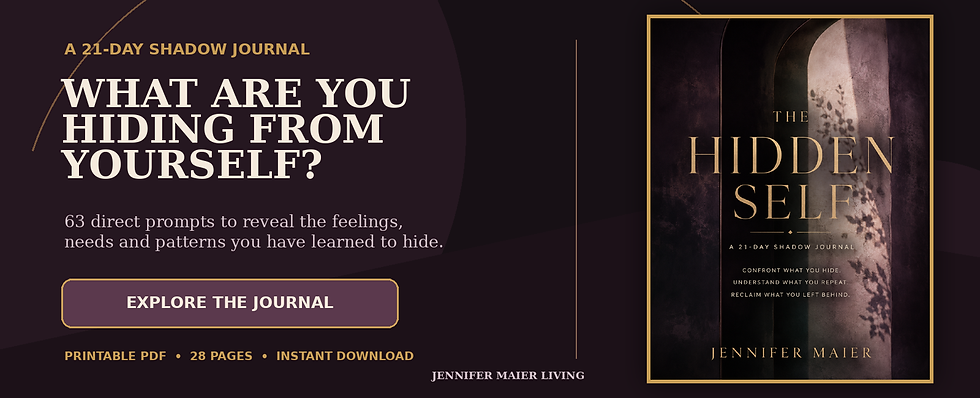
If you are ready to explore what you have hidden, The Hidden Self: A 21-Day Shadow Journal was created to give that exploration a clear structure. Each day presents three direct questions with substantial room to write. Over 21 days, you will examine the person you present, the rules you learned, the emotions you suppress, the approval you chase, the needs you hide and the patterns you continue repeating.
The questions eventually turn toward what you want to reclaim: the strengths you overlook, the desires you dismiss and the parts of yourself you may be ready to stop concealing. The 28-page journal is an instant digital PDF that can be printed or used with a compatible tablet annotation app.
Completing a shadow journal will not answer every question about your past, but it can help you recognize what has been influencing your present. You may discover that you are not hiding something terrible from yourself. You may simply be hiding something true.


Comments