The Lost Art of Slow Living

Updated: Aug 23
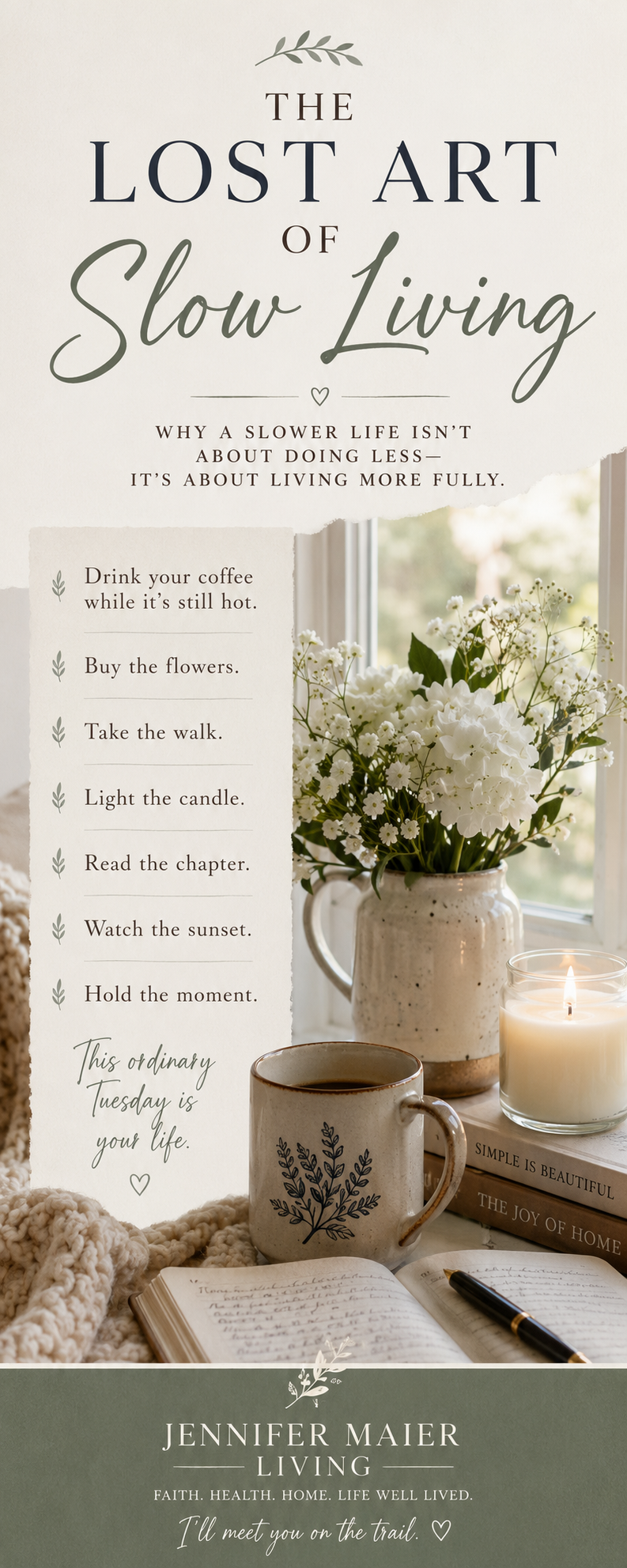
Why a slower life isn't about doing less—it's about living more fully.
There was a time when I believed the fullest life was the busiest one.
A calendar filled with meetings meant I was productive. A never-ending to-do list meant I was responsible. If I answered one more email before bed, squeezed in one more errand on the way home, or crossed one more task off my list before dinner, I ended the day believing I'd accomplished something worthwhile. Like so many women, I wore busyness almost like a badge of honor. I wasn't trying to rush through my life. I simply thought that was what a meaningful life looked like.
Somewhere along the way, though, I began noticing something that quietly unsettled me. I was becoming remarkably efficient at getting through my days, but I wasn't always very good at experiencing them. I drank my coffee while checking email. I ate lunch while answering text messages. I took walks while thinking about everything waiting for me when I got home. Even when I was with people I loved, part of my mind was often somewhere else, already planning tomorrow.
The strange thing is that none of this happened overnight. No one ever told me to hurry through my life. In fact, I don't think any of us consciously choose that. It happens one small decision at a time. We become accustomed to multitasking, rushing from one responsibility to the next, filling every quiet moment with another notification, another obligation, or another reason to keep moving. Before we realize it, we're no longer simply living our lives. We're managing them.
Lately, I've found myself wondering a different question. What if we've confused being busy with truly living?
What if the life we've been searching for isn't waiting on the other side of a less crowded calendar or a perfectly organized planner? What if it's been quietly unfolding in the ordinary moments we've been hurrying past all along? The morning cup of coffee that deserved five more minutes. The walk that didn't need a destination. The fresh flowers on the kitchen counter. The conversation we almost rushed through. The book we kept meaning to read. The Tuesday evening dinner that didn't need a special occasion to deserve linen napkins and candlelight.
I think we've lost something. Not our ambition. Not our work ethic. Not our desire to build meaningful lives. I think we've lost the ability to linger. We've forgotten that ordinary moments aren't interruptions to life. They are life.
Over the past year, I've found myself moving in a different direction. Not because I have everything figured out, and certainly not because my life has become less busy. If anything, I've taken on new dreams, new challenges, and new responsibilities. But somewhere in the middle of writing, walking, healing, creating jewelry, tending to my health, preserving history, and building Jennifer Maier Living, I've realized I'm no longer chasing a faster life.
I'm trying to build a fuller one. Perhaps that's what slow living has always been about.
Not escaping our lives. Finally being present enough to experience them.

The World Keeps Asking Us to Hurry
I don't think we've become busy because we don't know any better. I think we've become busy because the world quietly rewards it.
The people who answer emails the fastest are often praised for being responsive. The people with the fullest calendars are described as successful. We admire those who seem able to juggle careers, families, volunteer work, friendships, appointments, and endless responsibilities without missing a beat. Somewhere along the way, many of us began believing that a full life and a full schedule were the same thing.
Without realizing it, we learned to multitask almost everything.
We answer emails while eating lunch. We watch television while scrolling through our phones. We listen to podcasts while folding laundry, return text messages while standing in line, and think about tomorrow while driving home from work. Even when we finally sit down to rest, many of us reach for another screen instead of allowing our minds to become still. We've become so accustomed to doing two things at once that giving our full attention to one thing almost feels unfamiliar.
I don't say this with judgment because I'm describing myself as much as anyone else.
There have been countless evenings when I sat down with a cup of coffee, fully intending to enjoy a few quiet minutes, only to find myself checking email, responding to messages, and mentally rewriting tomorrow's schedule before I'd taken my second sip. I wasn't trying to ignore the moment. I simply wasn't in it.
Perhaps the greatest illusion we've accepted is that rest must be earned.
We'll rest after the house is clean. After the laundry is folded. After the inbox is empty. After one more meeting. After one more project. After one more obligation.
The trouble is that there is always one more thing waiting for us tomorrow. If rest only comes after everything is finished, many of us will spend our entire lives waiting for permission to slow down.
I've also noticed how easily productivity becomes part of our identity. We stop describing ourselves by who we are and begin describing ourselves by what we accomplish. A productive day feels like a successful day. A quiet afternoon can leave us feeling strangely guilty, as though simply sitting on the porch with a good book somehow means we're wasting time. It's remarkable how quickly we apologize for doing something that restores us while never apologizing for exhausting ourselves. Lately, I've been asking myself a question that has been surprisingly difficult to answer.

What are we racing toward?
If we hurry through breakfast to answer another email, hurry through dinner to get to the next obligation, hurry through conversations because we're thinking about what comes next, and hurry through ordinary Tuesdays while waiting for life to slow down, what exactly is waiting for us at the finish line?
Perhaps there isn't one.
Perhaps life was never meant to be a race in the first place. Perhaps we've simply become so accustomed to hurrying that we've forgotten another way to live.
The Beauty Hidden in Ordinary Moments
The older I get, the more convinced I become that the best parts of life rarely announce themselves.
They don't arrive with fireworks or applause. They don't usually appear on our calendars months in advance. More often than not, they slip quietly into ordinary Tuesdays while we're busy waiting for something more exciting to happen. I wonder how many beautiful moments I've rushed through simply because I assumed the important ones were still somewhere ahead of me.
Lately, I've been trying to notice the moments I used to overlook.
The first cup of coffee while it's still hot. Sunshine stretching across the kitchen floor early in the morning. Fresh flowers on the counter that somehow make the entire room feel happier. The familiar sound of birds outside the window while I'm writing. A slow walk through the neighborhood with no destination in mind. A candle burning quietly beside me while I read another chapter before bed.
None of those moments would look particularly remarkable in someone else's eyes.
Yet together they have become the life I'm learning to treasure.
I've also stopped believing that ordinary days need extraordinary reasons to be celebrated. Some evenings my husband and I eat grilled chicken and vegetables from our everyday plates, unfold linen napkins, light a candle, and linger at the table long after dinner is over. There's nothing fancy about the meal. No one is coming over. It isn't an anniversary or a holiday. It's simply Tuesday.
I've discovered that Tuesday deserves beauty too.
For so many years, I saved beautiful things for later. The good dishes. The favorite candle. The pretty flowers. The cloth napkins. Somehow I believed they should be reserved for guests or special occasions, as though ordinary life hadn't yet earned them. Now I find myself wondering why I waited.
Perhaps ordinary life has always been the special occasion. Some of my happiest moments aren't the ones I've carefully planned. They're the quiet Saturday mornings when the windows are open and the house is still. They're afternoons spent wandering through a garden center without buying much of anything. They're evenings curled beneath a blanket with a good book while rain taps against the windows. They're conversations that linger because no one is in a hurry to leave.

These are the moments that restore me. They're also the moments I suspect we'll remember.
When I think back over the years, I don't remember every meeting I attended or every item I crossed off another to-do list. I remember my mother's laugh. Long dinners with people I love. The smell of coffee brewing before the house woke up. The first cool breeze after a long Alabama summer. A porch swing moving gently at sunset. Holding a warm mug in both hands on a chilly morning.
Perhaps we've spent too much of our lives waiting for extraordinary moments while quietly overlooking the extraordinary beauty that has been surrounding us all along.
Maybe the richest parts of life have never been hidden. Maybe they've simply been waiting for us to slow down long enough to notice them.
The Slow Rituals That Changed My Life
The interesting thing about change is that it rarely arrives all at once.
I don't remember waking up one morning and deciding I was going to become someone who embraced slow living. There wasn't a dramatic turning point or a single life-changing decision. Looking back, I can see that my life changed because of a collection of small rituals that slowly reshaped the way I moved through my days. At the time, none of them seemed particularly significant. They simply became little moments I began looking forward to, and over time they quietly changed me.
Walking was one of the first.
When I first started walking regularly, my goal was simple. I wanted to lose weight. Somewhere along those miles, though, the purpose of my walks began to change. They became the place where I prayed, worked through difficult decisions, dreamed about the future, and noticed things I had been too busy to see before. Some of the ideas that eventually became Jennifer Maier Living first appeared while I was walking beneath a canopy of trees with nothing but my thoughts for company. I still enjoy the health benefits, but I no longer think of walking as exercise alone. It's become one of the ways I make space for my own mind.
The same thing happened around my dinner table. For years, I approached food with a sense of anxiety. I worried about calories, carbohydrates, and whether I'd somehow ruined another day by making the wrong choice. Little by little, I stopped asking myself whether I had eaten perfectly and started asking something much gentler: What does my body need today? That one question transformed my relationship with food. It eventually became the foundation for what I now call Protein Before Perfection, but the philosophy extends far beyond nutrition. It's really about choosing nourishment over perfection in every area of life.
Writing became another unexpected ritual. I've always loved words, but for years they were mostly reserved for work. It wasn't until I began writing these essays that I realized how restorative it could be to sit quietly with a cup of coffee, open my laptop, and simply pay attention to my own thoughts. These essays aren't written because I have life completely figured out. They're written because slowing down long enough to reflect has become one of the ways I continue growing. Writing has helped me understand my own journey as much as it's helped me share it with others.

I've noticed the same thing in the quieter corners of my life. Fresh flowers on the kitchen counter remind me that beauty doesn't need a special occasion. Lighting a candle before I settle into a book tells my mind the workday is over. Spending time designing jewelry reminds me that creativity isn't a luxury—it's part of who I am. Even my work at the museum has taken on a different meaning. Every day I'm surrounded by stories that have survived generations, quietly reminding me that the things we preserve reveal what we truly value. That thought has stayed with me. It makes me wonder what my own daily habits are preserving.
Perhaps the most important ritual of all has become prayer. Not hurried prayers squeezed between meetings or whispered while rushing out the door, but quiet conversations with God during walks, early mornings, or peaceful evenings at home. Those moments remind me that my worth has never depended on how much I accomplish before bedtime. They gently redirect my attention toward gratitude instead of hurry, presence instead of productivity, and faith instead of fear. I've come to believe that one of the greatest gifts of slowing down is finally having enough quiet to hear the things that busyness has been drowning out.
None of these rituals changed my life overnight. Walking one morning didn't transform me. Neither did lighting one candle, buying one bouquet of flowers, writing one essay, or eating one healthy meal. But together they slowly changed the direction of my life. Looking back, I realize I wasn't building better habits. I was building a better life.
There are moments in life that divide everything into before and after. Not because we planned them. Because they arrived without asking our permission.
For me, one of those moments was the afternoon I fell and broke my arm. One instant I was thinking about tomorrow's schedule, the projects waiting for me at work, and everything I still hoped to accomplish before the week was over. The next, none of those plans mattered. My calendar didn't disappear, but my ability to keep up with it certainly did. Surgery, recovery, doctor's appointments, physical therapy, and the simple reality of learning to do everyday tasks with one arm suddenly became my new routine.
I'll be honest. At first, I hated it. I've always been independent. I'm the person who likes solving problems, figuring things out, and taking care of myself. Suddenly I needed help getting dressed, washing my hair, carrying groceries, and doing things I'd performed without a second thought for decades. I wasn't frustrated because my arm hurt. I was frustrated because my independence had been interrupted.

Looking back now, I can see that something much deeper happened during those weeks.
For the first time in a very long time, I couldn't hurry. There was no way to rush healing. No shortcut around recovery. No amount of determination could convince my body to move faster than it was ready to move. Every day asked something entirely different of me. Instead of accomplishing more, I had to learn how to simply be where I was. Strangely enough, that season of forced stillness became one of the most creative seasons of my life.
Because I couldn't do everything I normally did, I finally had the space to think about what I truly wanted to do. Ideas I'd been carrying around for years suddenly had room to breathe. I began writing more seriously than I ever had before. Jennifer Maier Living, which had existed only as scattered thoughts and quiet dreams, slowly began taking shape while I was healing. The very interruption I believed had delayed my life became the thing that redirected it.
I've thought about that often. How many dreams remain buried beneath busy schedules?
How many good ideas are crowded out simply because we've left ourselves no margin to hear them? I used to think slowing down meant life had been put on hold.
Now I wonder if slowing down sometimes allows life to finally catch up with us. My arm eventually healed. I regained my independence. The calendar filled back up. Life moved forward.
But I don't think I'll ever look at time the same way again. That season taught me something I hope I never forget. Sometimes life doesn't fall apart. Sometimes it quietly rearranges itself into something we never would have chosen—but later realize we desperately needed.
I would never choose to break my arm again. But I would choose what it taught me.
Because somewhere in the middle of recovery, frustration, dependence, and long quiet afternoons. I stopped measuring my days by how much I accomplished. I started measuring them by how fully I lived them.
Perhaps Slow Living Isn't About Slowing Down
When I first began thinking about slow living, I assumed it meant doing less. I pictured a quieter calendar, fewer commitments, and a slower pace. The longer I've lived with the idea, though, the more I realize I had misunderstood it. Slow living isn't really about reducing the number of things we do. It's about becoming fully present for the life we're already living. It's about noticing the moments we used to rush through without realizing they were quietly becoming our memories.
One day, I doubt any of us will remember how many emails we answered or how many errands we squeezed into a Saturday afternoon. What we'll remember are the conversations that lingered around the dinner table, the walks we took with people we loved, the laughter that caught us by surprise, and the fresh flowers we bought simply because they made an ordinary Tuesday feel a little brighter.
We'll remember the smell of coffee brewing before the rest of the house woke up, the warmth of a candle on a rainy evening, the comfort of a favorite chair, and the peaceful feeling of finally putting our phones down long enough to listen to the birds outside the window. Those moments may seem ordinary while we're living them, but I have a feeling they're the moments that quietly become the story of our lives.
Perhaps that's why this way of living has become so important to me. I'm no longer trying to build a life that simply looks successful from the outside. I'm trying to build one that feels meaningful from the inside. I want to care well for my body, but I also want to care for my relationships, my creativity, my home, and my faith. I want to preserve history, write words that matter, create jewelry with my own hands, walk beneath trees that have stood for generations, and surround myself with simple beauty that reminds me to pay attention. More than anything, I want to reach the end of my life knowing I experienced it instead of simply managing it.
The truth is, life will probably never become less demanding. There will always be deadlines, responsibilities, unexpected interruptions, and seasons that require more from us than we think we have to give. Slow living doesn't ask us to abandon those responsibilities. It simply asks us not to let them become the only story we're living. It invites us to protect little pockets of peace in the middle of ordinary days and to believe those moments matter just as much as the accomplishments the world applauds.
If you've read this far, perhaps some part of this essay has felt familiar. Maybe you're tired in a way that sleep alone can't fix. Maybe you've spent years caring for everyone around you while quietly forgetting what restores your own heart. If that's where you find yourself today, I hope you won't leave here feeling as though slow living is one more expectation to add to your list. I hope you'll simply choose one small moment tomorrow and experience it completely. Drink your coffee while it's still hot. Buy the flowers. Light the candle. Read another chapter. Sit on the porch a little longer. Take the long way home. Watch the sunset without reaching for your phone. Say an unhurried prayer. None of those things will change your life overnight, but together they might gently change the way you experience it.
I've come to believe that ordinary Tuesdays aren't standing in the way of our lives. They are our lives. Perhaps that's what slow living has been trying to teach us all along—not to accomplish less, but to notice more. And maybe the richest, fullest life isn't waiting somewhere in the future after we've finished everything on our list. Maybe it's been here all along, quietly waiting for us to slow down just enough to see it.
Jennifer 🌿


Comments