You Don’t Need a Different Life. You May Need a Different Pace.

There is a fantasy version of slowing down that I find very appealing. In this version, I have nowhere I particularly need to be. I wake up without an alarm, drink coffee while looking thoughtfully out a window at something scenic, and wander around doing things at a pace normally associated with women in linen pants in pharmaceutical commercials. Nobody needs anything from me, nothing is beeping, nothing is late, and apparently I have enough money that none of this is concerning.
It sounds wonderful. It also bears almost no resemblance to the way most of us actually live.
For years, I thought slowing down belonged to some future version of life. Maybe after retirement. Maybe after the mortgage was paid. Maybe after the obligations diminished, the calendar cleared and everyone stopped needing something. I treated a slower life almost like a vacation destination: lovely to imagine, but not somewhere I could actually live.
The problem is that life has a rather annoying habit of continuing. There will always be something that needs doing. Groceries do not become less necessary because you have decided to embrace intentional living. The dentist still expects you Thursday at two, the dog has absolutely no interest in your new boundaries regarding morning responsibilities, and somebody will eventually ask if you can do “one little thing,” which experience has taught me occasionally has the wingspan of a small aircraft.
Maybe slowing down was never supposed to mean escaping ordinary life. Maybe it means learning to live ordinary life differently.
When Hurry Becomes a Habit
For a long time, I was very good at being busy. I could make a schedule, fill a schedule and then become mildly offended that the schedule I had personally created expected so much from me. Busyness can be strangely satisfying that way. A full calendar can make us feel necessary, productive and important, even when we're exhausted by everything written on it.
Eventually, moving from one obligation to another can become so normal that an empty hour actually makes us uncomfortable. We start wondering what we're forgetting and searching around for something productive to do with time that, only moments earlier, belonged entirely to us. There is always an email that could be answered, a closet that could be organized, an errand that could be run or something we could get ahead on for tomorrow. We become so skilled at filling our lives that eventually there is very little room left to actually experience them.
I think slowing down begins when we stop treating every available piece of time as an opening that needs to be filled. An empty hour isn't necessarily wasted time; sometimes it is simply an hour that still belongs to you. That distinction can feel almost rebellious when you've spent years measuring a good day by how much you accomplished. It requires accepting that rest, thought, conversation and simple enjoyment do not have to produce anything to justify the time they occupy.
One of the most useful things I have learned is that something can need to be done without needing to be done right now. That sounds ridiculously simple until you notice how often we ignore it. We carry enormous invisible lists of things that could be handled, improved, answered, organized, scheduled or completed, and because all of them are legitimate tasks, we begin treating all of them as equally urgent. They aren't.
The linen closet is not an emergency. Neither is the email that can wait until tomorrow, the errand that would save you twelve minutes on Wednesday or the favor you agreed to because saying no felt more uncomfortable than rearranging your entire afternoon. Sometimes the most useful question you can ask yourself is simply, Does this actually need me today? Quite often, the answer is no, and realizing that isn't laziness; it's deciding that you get some say in what receives your attention.

A Slower Life Can Still Be a Full One
I don't want an empty life, and I think that's an important distinction. I want people I love, work that interests me, projects that make me lose track of time, books to write, places to go and things to learn. I want days when I accomplish something difficult and feel wonderfully tired afterward. Slowing down isn't about removing everything from life until nothing remains.
It's about leaving enough room around the things that matter that you can actually enjoy them. It's having a conversation without mentally moving ahead to the next obligation, eating without simultaneously answering messages, and going somewhere without calculating how many errands you can cram into the return trip. Efficiency is useful, but it doesn't have to become a personality. There are moments when the most efficient use of an afternoon may not be the best use of it.
Sometimes slowing down is remarkably unimpressive. It might mean sitting outside for twenty minutes, leaving tomorrow's task for tomorrow, driving home instead of making one more stop or reading another chapter because you want to know what happens. It might mean not answering immediately or deciding that something is good enough instead of improving it one more time. Nobody watching from across the street would realize that anything important had happened, but those small decisions are often where we begin reclaiming our lives.
The Life We Keep Waiting to Enjoy
We spend an extraordinary amount of time imagining what would have to change before we could live differently. We'll slow down when work settles down, when the children are older, when there's more money, when we're retired or when life becomes easier. There is always some future version of ourselves who supposedly has more time than we do. Unfortunately, she remains stubbornly unavailable for comment.
What if the life we keep waiting to enjoy is already happening? That doesn't mean everything about it is wonderful. Some seasons are genuinely hard, some responsibilities cannot be declined, and some days require us to move quickly because life occasionally does not care about our philosophical commitment to a gentler pace. But hurry does not have to become our permanent setting.
We can begin deciding what deserves urgency and what doesn't. We can leave margin around our days, stop volunteering every unclaimed hour for duty and become a little less impressed by how much we can cram into twenty-four hours. Maybe the better question at the end of the day isn't always How much did I get done? Maybe sometimes it's Did I actually notice any of the life I was so busy managing?
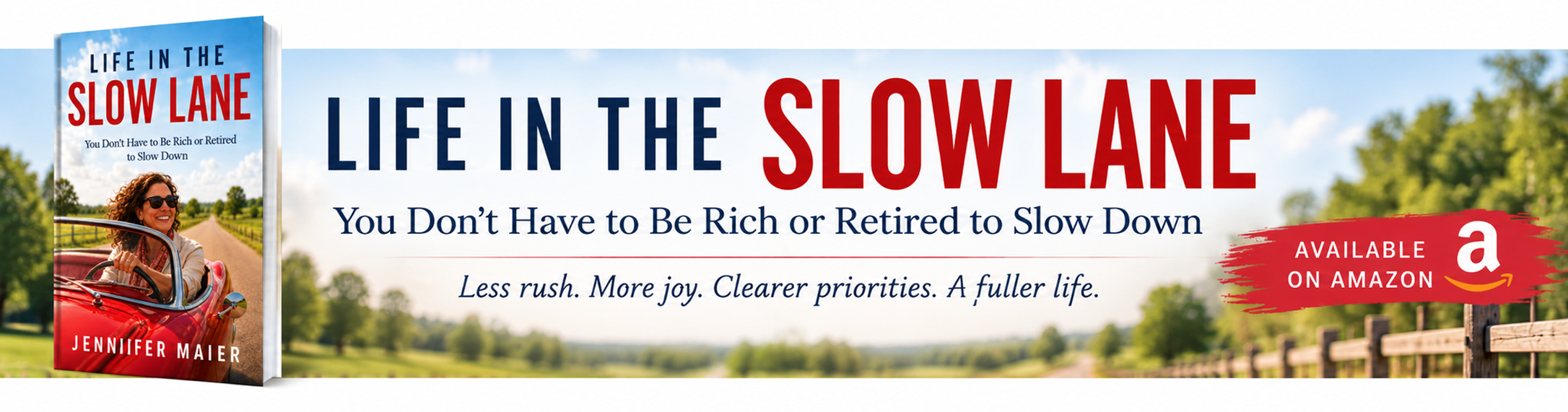
That realization became part of the reason I wrote Life in the Slow Lane: You Don't Have to Be Rich or Retired to Slow Down. I wasn't interested in writing about escaping ordinary life. I wanted to explore how we might live ordinary life differently—how we might protect more of our time, become clearer about what matters and stop postponing a fuller life until some imaginary future when everything finally settles down.
Maybe you don't need a cabin in the mountains, unlimited money, retirement or even a pair of linen pants. You may not need a different life at all. You may simply need to stop racing through the one you already have long enough to discover that there are parts of it you quite like.


Comments