The Art of Beautiful Maximalism

Updated: Aug 19
Why a Home Filled with Meaning Will Never Go Out of Style
There was a time when it seemed every decorating magazine was asking us to remove something. Clear the shelves. Edit the accessories. Take down the pictures. Leave more empty space. Somewhere along the way, the design world began equating beauty with restraint, and the quieter a room became, the more sophisticated it was said to be. White walls, carefully edited bookshelves, and coffee tables holding little more than a single candle became the aspiration. The message was subtle but unmistakable: if your home looked lived in, perhaps you were doing something wrong.

I've admired many of those rooms over the years. They photograph beautifully. Their simplicity feels peaceful, and I understand why so many people are drawn to them. But every time I stepped inside a minimalist home, I found myself feeling the same thing. It was lovely to visit, but it never felt like somewhere I wanted to stay.
Because home, at least to me, has never been about emptiness. It has always been about layers.
I've been collecting my home for more than thirty years. Not intentionally at first. Certainly not because maximalism had become fashionable again. I simply bought what I loved. One antique tea caddy led to another. A beautiful blue-and-white ginger jar found its way home from an antique store. Coffee-table books accumulated because I couldn't resist opening them in bookstores. Linen throws, velvet pillows, brass candlesticks, old silver, chinoiserie, framed artwork, woven baskets, and stacks of well-loved books slowly filled the spaces around me until one day I realized something wonderful had happened.
Without ever setting out to decorate in a particular style, I had built a home that looked unmistakably like my life. Every room tells a story.
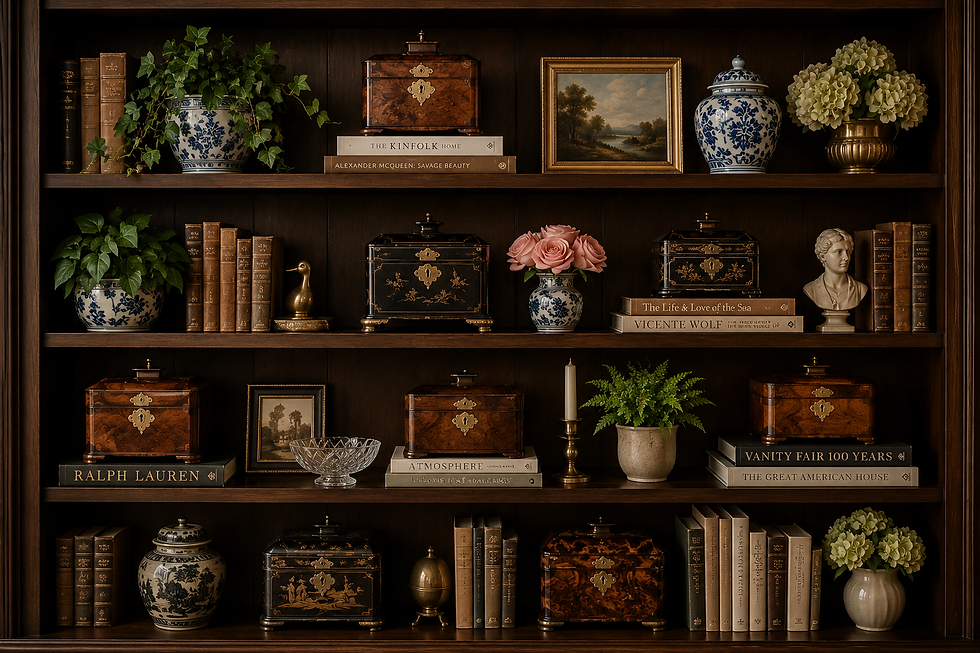
The tea caddies remind me of weekends spent wandering antique malls with no particular destination in mind. Certain pieces of china immediately transport me back to little shops discovered while traveling. Books lining my shelves aren't there because their spines happen to coordinate with my color palette. They're there because they changed the way I think, inspired a future project, or simply made me smile enough that I couldn't imagine parting with them. Even the pillows scattered throughout the house carry memories. Some were purchased after years of searching for exactly the right fabric. Others came home with me simply because they made an ordinary Saturday feel a little more beautiful.
Perhaps that's why I've never understood the idea of decorating solely to impress other people. A home should reveal something about the people who live there. Not about the latest trend.
Lately, however, it seems the design world is beginning to rediscover what many collectors have quietly believed all along. Maximalism has returned, although I sometimes wonder if "returned" is really the right word. For many of us, it never left. While decorating styles have come and gone over the decades, there have always been people whose homes reflected years of thoughtful collecting rather than a single shopping trip. Their rooms evolved slowly. Furniture was inherited. Artwork was discovered. Books accumulated naturally. Nothing matched perfectly, yet somehow everything belonged together.
I think that's the difference people are responding to now. In a world where so much feels temporary, collected homes feel permanent. They remind us that beautiful rooms don't have to be finished in a weekend. They can unfold over decades, growing richer as our lives grow richer. Every vacation adds another memory. Every flea market holds the possibility of finding something unexpected. Every antique store offers the chance to bring home a piece with a story that began long before ours.
Of course, maximalism is often misunderstood. The word itself sometimes makes people picture crowded rooms where every surface disappears beneath collections and every wall competes for attention. Beautiful maximalism isn't about owning more simply for the sake of owning more. It's about surrounding yourself with things that carry meaning. There is an enormous difference between a room that has been thoughtfully collected and one that has simply accumulated clutter.
Clutter usually happens by accident. It grows because decisions have been postponed, closets overflow, and things remain simply because no one has taken the time to decide what should stay. A collected home is something entirely different. Every object has earned its place. Every layer contributes to the story. The antique clock isn't filling an empty corner. The stack of books isn't hiding a bare tabletop. They belong because they reflect the people who live there.
As I've grown older, I've realized that decorating isn't all that different from healthy living. Neither is built overnight. We don't become healthier through one perfect meal any more than we create a meaningful home during one shopping spree. Both are the result of hundreds of small decisions made over many years. We choose nourishment instead of convenience. We choose beauty instead of trends. We choose objects that make us feel something instead of buying simply to fill a space.
When I look around my home today, I don't really see decorating. I see chapters. I see years spent becoming the person I am today. I see books that challenged me, artwork that stopped me in my tracks, gifts from people I love, and little treasures discovered on quiet afternoons when I wasn't looking for anything in particular. Together they've created something far more valuable than a beautifully decorated room.
They've created a home that feels deeply, unmistakably ours. And perhaps that's the greatest lesson maximalism has to teach us. The goal was never to own more. The goal was always to love more—and to let our homes become a reflection of a life that has been beautifully, thoughtfully, and joyfully lived.
The Secret Is in the Layers
One of the biggest misconceptions about maximalism is that it's created by adding more.
It isn't. It's created by layering better. When people walk into a home that feels warm, collected, and effortlessly beautiful, they often assume the homeowner has an extraordinary eye for decorating. While good design certainly helps, what they're usually responding to isn't one spectacular piece of furniture or an expensive chandelier. It's the layers. The room feels finished because every surface, texture, color, and object contributes something to the story.
The first thing I notice when I walk into a beautifully designed room is rarely the sofa.
It's the feeling. Some rooms immediately invite you to exhale. They feel warm, welcoming, and comfortable before you've even found a place to sit. I don't believe that's accidental. Those rooms have been thoughtfully layered over time, creating visual interest that makes us want to slow down and stay awhile.
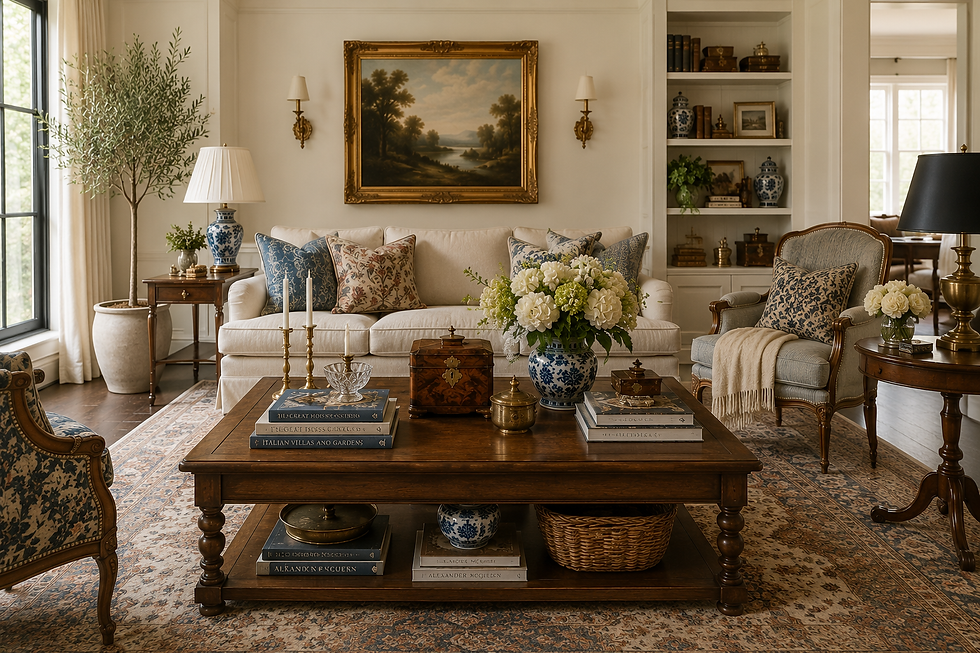
When I decorate, I don't think in terms of buying furniture. I think in terms of building atmosphere.
Furniture creates a room. Layers create a home.
Books Are Never Just Books
If you've spent any time in my home, you've probably noticed that books seem to appear everywhere.
They're stacked on coffee tables, tucked onto side tables, arranged beneath lamps, lining bookshelves, and occasionally balancing beneath a favorite decorative object that needed just a little more height. Some people decorate with accessories. I decorate with books.
Not because they happen to match the room. Because they've shaped the person living in it.
Every book tells two stories. One belongs to the author. The other belongs to the reader. I can look across a room and remember exactly where I bought a particular book, what season of life I was living through when I read it, or why I couldn't bear to donate it years later. Those memories become part of the room just as surely as the furniture does.
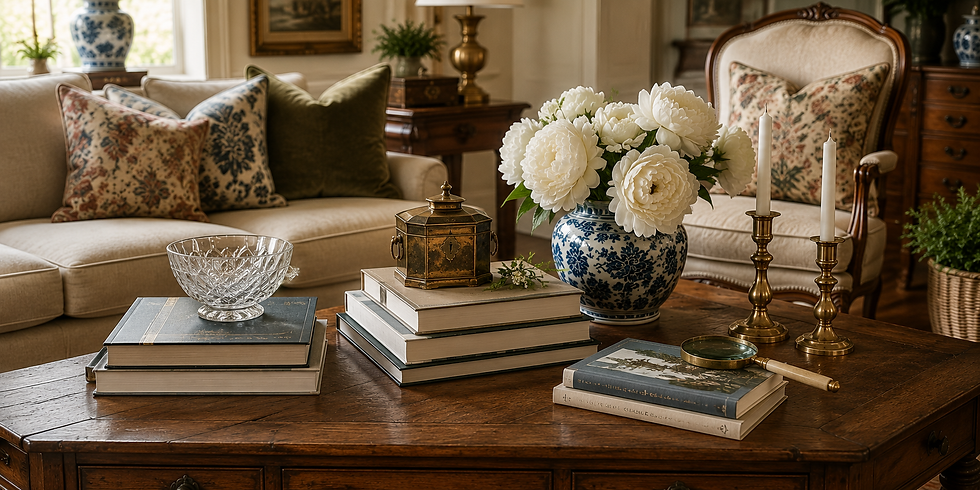
Coffee-table books deserve special mention because they accomplish something rather wonderful. Yes, they're beautiful to look at, but they're also invitations. Guests naturally pick them up. Conversations begin. Someone discovers a shared interest in gardening, architecture, antiques, or travel. Without realizing it, books become one of the easiest ways a home begins introducing the people who live there.
I don't think books should ever be chosen simply because the bindings match your color palette.
Choose them because you'll actually want to open them.
The Quiet Luxury of Textiles
If books give a room personality, textiles give it warmth. One of the easiest ways to make a room feel collected rather than flat is by introducing different textures. Linen curtains soften sunlight in a way that instantly changes the mood of a room. Velvet pillows add richness without demanding attention. Woven baskets, chunky knit throws, embroidered cushions, and soft wool rugs all contribute something different. Individually they may seem insignificant. Together they create the feeling that a room has evolved naturally over time.
I sometimes laugh when people ask how many pillows is too many. The honest answer? I have absolutely no idea. I simply know when a room feels inviting. A sofa with one lonely pillow often feels unfinished to me. Add layers of linen, velvet, embroidery, and perhaps a favorite throw draped casually over one arm, and suddenly the entire room becomes somewhere you instinctively want to curl up with a good book and a cup of coffee. Texture does something color alone never can. It makes a room feel alive.
Let Your Collections Tell the Story
One of the greatest mistakes people make is believing collections have to be valuable before they're worth displaying. Nothing could be further from the truth. Some of my favorite collections would probably mean very little to anyone else. Antique tea caddies. Blue-and-white chinoiserie. Brass candlesticks gathered over decades. Little pieces discovered while traveling that remind me of places I've loved. Their value has very little to do with rarity or price. Their value lies entirely in the memories attached to them.
Collections give visitors little glimpses into who we are. They quietly answer questions no one thought to ask. What fascinates you? What have you searched for over the years? What makes you stop while wandering through an antique store?
Those answers become visible without a single word being spoken. One beautifully displayed collection almost always creates more impact than dozens of unrelated decorative objects scattered throughout a room. When similar pieces are grouped together, they begin telling a story rather than competing for attention. That's one of the secrets of beautiful maximalism. Even abundance benefits from organization.
Every Room Needs Something Living
Flowers have always had an almost magical ability to make a room feel happier. Perhaps it's because they're temporary. They quietly remind us to notice beauty while it's here. Fresh flowers don't have to be reserved for holidays or company. Some of my favorite arrangements have come from grocery store bouquets separated into smaller vases and scattered throughout the house. Suddenly the kitchen, guest room, powder room, and bedside table each have a little reminder that ordinary days deserve beauty too.
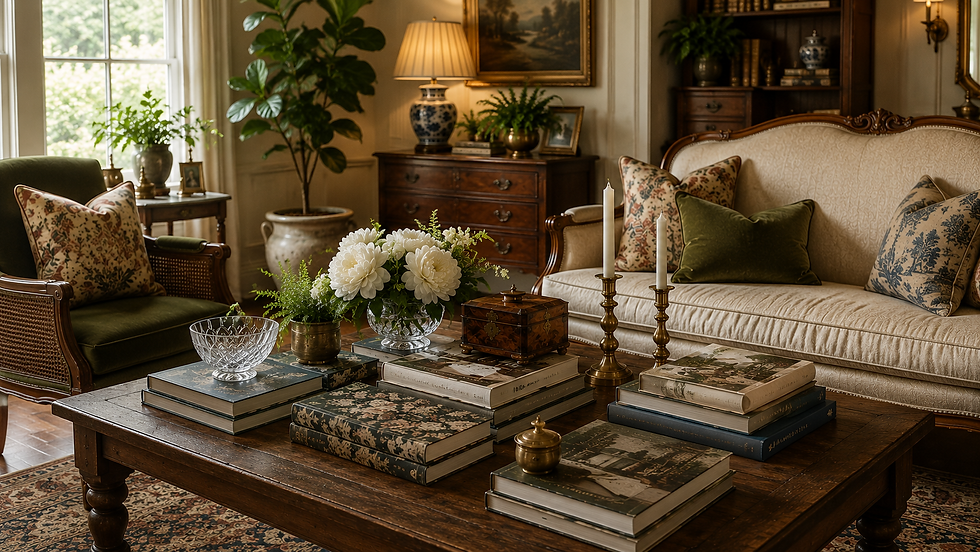
Houseplants accomplish something slightly different. Where flowers bring color, plants bring life. A trailing pothos spilling from a bookshelf, an olive tree standing proudly in a sunny corner, or a simple fern softening a bathroom shelf somehow makes a room feel as though it's breathing. Even homes filled with antiques and collected treasures benefit from something green quietly growing among them.
Nature has a remarkable way of softening interiors. I don't think that's an accident.
Lighting Changes Everything
I've often said that lighting is one of the most overlooked decorating tools we have.
A beautifully decorated room can feel cold beneath harsh overhead lighting. Meanwhile, an ordinary room filled with warm pools of lamplight suddenly becomes incredibly inviting. I rarely rely on ceiling fixtures alone. Instead, I think of lighting in layers.
A table lamp beside the sofa creates a cozy reading corner. Picture lights bring artwork to life after sunset. Candlesticks flicker softly during dinner. Library lamps illuminate stacks of books. Together they create a room that feels intimate rather than overly bright. There is a reason restaurants dim the lights in the evening. Soft light encourages us to linger. Perhaps our homes should do the same.
Mixing Old and New
One of my favorite decorating philosophies is that every room should feel as though it has evolved naturally over many years rather than arriving in a single delivery truck. I love mixing antique furniture with newer upholstery, vintage artwork beside modern lamps, inherited silver resting on contemporary shelving, and old books stacked beside freshly cut flowers. The contrast creates interest because nothing feels overly predictable.
When everything in a room is brand new, it sometimes lacks a sense of history. When everything is antique, it can occasionally begin feeling like a museum. Somewhere between the two lies the sweet spot—a home that feels current while still honoring the stories that came before us.
Perhaps that's why I've never worried much about whether everything matches perfectly. Life doesn't.
And somehow it's more beautiful because of it.
As I look around my own home today, I realize very little of it was decorated according to a master plan. It simply grew alongside my life. One room inspired another. One collection led naturally to the next. One beautiful object quietly found its place beside another until the house slowly became a reflection of the people living inside it.
I've come to believe that's exactly what our homes should do. Not impress strangers. Welcome the people we love. And remind us, every single day, that beauty isn't created all at once. It's collected—one meaningful layer at a time.
Room by Room—Creating a Home That Invites People to Stay
Every beautifully layered home has one thing in common. It doesn't feel as though someone decorated it. It feels as though someone lives there. That's a surprisingly important distinction.
The most memorable homes aren't the ones where every pillow perfectly coordinates with the artwork or every accessory came from the same collection. They're the homes where you immediately sense the personality of the people who live there.
You notice books that have actually been read, family photographs displayed because they make someone smile, flowers gathered from the garden, and collections that have been assembled over years instead of weekends. Perhaps that's why I've never approached decorating by asking, "What does this room need?" Instead, I ask, "How do I want this room to feel?" Every decision after that becomes much easier.
The Living Room: Where Stories Begin
If the kitchen is the heart of the home, I think the living room is where its personality becomes most visible. It's the room where conversations unfold, where grandchildren build blanket forts, where friends linger over coffee long after the dessert plates have been cleared, and where quiet evenings often end with a book and a favorite blanket. It deserves to feel comfortable before it ever feels impressive.
One of the easiest mistakes people make is pushing all of their furniture against the walls. We leave a large empty space in the middle of the room and unintentionally create distance between the people sitting there. Instead, think about arranging furniture for conversation rather than television. Sofas and chairs should invite people to look toward one another. The room should quietly encourage connection.
Once the furniture is in place, begin layering. A coffee table becomes far more interesting when it holds a stack of beautiful books, a candle that's actually burned, a small vase of flowers, and perhaps a decorative box that hides the television remote. Add a tray to organize the arrangement, and suddenly the table feels thoughtfully collected rather than cluttered.
I also believe every living room benefits from something unexpected. Perhaps it's an antique globe discovered at an estate sale, an oversized piece of artwork leaning casually on a bookshelf, or an old brass telescope sitting beside a favorite reading chair. These are the details guests remember because they're expressions of curiosity rather than decoration.
The Kitchen: The Most Loved Room in the House
For years, kitchens were designed almost exclusively around efficiency. Today, I think we're returning to something much warmer. The kitchens I love most don't simply function well. They invite people to gather.
A beautifully styled kitchen isn't created by hiding everything behind cabinet doors. It's created by thoughtfully displaying the things you genuinely use. Wooden cutting boards leaning against the backsplash, olive oil in a beautiful bottle, crocks filled with wooden spoons, stacked white dishes, woven baskets, fresh herbs growing by the window, and bowls of lemons quietly communicate that this is a room where meals are prepared and memories are made.
Open shelving works beautifully when it's treated like a collection rather than storage. Instead of filling every inch, group similar pieces together. Ironstone stacked beside vintage crocks. Blue-and-white china arranged with white serving bowls. Glass jars filled with pantry staples. The repetition creates calm, even though there is plenty to see.
I think kitchens become especially welcoming when they include something living. Fresh flowers, a bowl of seasonal fruit, or a simple potted herb immediately softens the room. It reminds us that kitchens are not simply places where food is prepared. They're places where life happens.
The Dining Room: Where Hospitality Lives
Some of my favorite memories have happened around a dining table. Not because the meals were elaborate. Because the conversations lingered.
I've never believed a dining room should feel so formal that everyone becomes nervous about sitting down. Beautiful china deserves to be used. Linen napkins become softer with every washing. Crystal sparkles just as beautifully on an ordinary Tuesday as it does during the holidays.
One of the easiest ways to create a welcoming dining room is to layer the table even when company isn't expected. A wooden bowl filled with pears, a pair of brass candlesticks, a stack of favorite cookbooks on the buffet, or fresh hydrangeas gathered from the garden quietly suggest that hospitality is always welcome here. Homes have personalities. A dining room should quietly say, "Stay a little longer."
The Bedroom: A Place to Exhale
Bedrooms are often the most overlooked rooms in the house because so few people see them.
That's exactly why they deserve our attention.
Your bedroom should be the most restful room in your home—not because it's empty, but because every element has been chosen with care. Layering becomes especially important here. Crisp white sheets beneath a linen duvet. A quilt folded across the foot of the bed. Velvet pillows mixed with embroidered cushions. Bedside tables holding books you're actually reading rather than decorative objects chosen simply to fill space.
Lighting matters here as much as anywhere. Soft bedside lamps create a sense of calm that overhead fixtures rarely achieve. Artwork above the bed, framed botanical prints, or antique mirrors help the room feel finished without becoming busy. This isn't about creating a room worthy of a magazine cover. It's about creating a room you look forward to returning to every evening.
Bathrooms Deserve Beauty Too
For years, I treated bathrooms as purely functional spaces. Now I think of them as opportunities.
One beautiful tray can completely transform a vanity. Arrange perfume bottles together. Roll white towels into a basket. Add a small vase of flowers, a candle, and perhaps a favorite hand cream displayed because it's lovely rather than hidden beneath the sink. Little luxuries matter. A vintage mirror. Beautiful soap. A small piece of artwork. Good lighting.
None of these changes are expensive, yet together they make ordinary routines feel more intentional.
The rooms we use every single day deserve to make us smile too.
Entryways Set the Tone
Your front door introduces your home long before anyone reaches the living room. I love entryways that immediately communicate warmth rather than perfection. An antique console table layered with books, a lamp, fresh flowers, and a beautiful mirror creates an inviting first impression. A woven basket waiting for umbrellas, a favorite piece of artwork, or an antique chair tucked into the corner tells guests they have arrived somewhere deeply personal.
The entryway doesn't need to be large. It simply needs to say, "Welcome."
Decorating Slowly Is Decorating Well
One of the greatest gifts I've given myself over the years is permission to decorate slowly.
I've never believed every room needs to be finished immediately. In fact, I think the most beautiful homes rarely are. Some of my favorite pieces spent months—or years—waiting for the right place to appear. I've walked away from antiques only to realize weeks later that I couldn't stop thinking about them. I've rearranged bookshelves dozens of times before everything finally felt balanced. I've learned that homes evolve in much the same way people do.
Gradually. Patiently. One thoughtful decision at a time. There is tremendous freedom in realizing our home doesn't have to be completed this season. It simply has to keep becoming more you.
As I walk through my own house today, I don't see decorating projects. I see thirty years of memories.
I see books collected one bookstore at a time, tea caddies discovered on antique adventures, chinoiserie that still makes me smile, fabrics I've loved for decades, and little reminders of a life that has been wonderfully full.
Perhaps that's what beautiful maximalism really is. Not filling a home with things. But filling it with stories. And there is no trend more timeless than that.
Decorating Isn't About Following Trends—It's About Trusting Yourself
One of the questions I hear most often is, "How do I know if something will work in my house?"
My answer almost always surprises people. If you love it, there's a very good chance it will.
For years we've been taught to decorate according to trends. One year everything should be gray. The next year it's beige. Then boucle arrives. Then curved furniture. Then dark walls. Then white kitchens. Decorating starts feeling less like creating a home and more like chasing fashion, always wondering if what you loved last year is somehow wrong this year.
I've never found much joy in decorating that way. Some of the things I treasure most in my home have been with me since I graduated from college. They're certainly not all fashionable, and that's precisely why I love them. They've outlived decorating trends because they were never purchased to impress anyone else. They came home with me because they made me feel something.
I've learned that the pieces you continue thinking about after you've left the antique store are often the ones you should have bought.
Some of the Best Decorating Happens Outside a Furniture Store
When people ask where I've found many of the pieces in my home, they're often surprised by the answer. Very few came from traditional furniture stores. Instead, they've been discovered while wandering antique malls on quiet Saturday afternoons, browsing estate sales early on a Friday morning, stopping at little roadside antique shops while traveling, or occasionally stumbling across something completely unexpected at a flea market.
I love that unpredictability. There is something wonderfully satisfying about finding a piece that no one else has. An antique tea caddy with beautiful patina. A stack of old leather books. A brass candlestick that has already lived a hundred years before finding its way into your home. Those objects carry a sense of history that simply can't be manufactured.
Even Facebook Marketplace has become one of my favorite places to browse. Every now and then, hidden among hundreds of ordinary listings, you'll discover something extraordinary. A vintage mirror. A solid wood chest. A beautiful lamp that simply needs a new shade. Decorating slowly gives you the luxury of waiting for those moments instead of settling for something that merely fills an empty corner.
Mix High and Low Without Apology
One of the things I enjoy most about decorating is mixing expensive pieces with affordable ones until no one can tell which is which. A beautiful antique chest can sit beside an inexpensive lamp from HomeGoods. Designer coffee-table books can rest on a flea-market stool. Fresh grocery-store flowers look just as beautiful in an antique silver pitcher as they do in an expensive crystal vase.
Homes become interesting when everything doesn't arrive from the same catalog. Perfection often feels impersonal. Contrast feels collected. Some of my favorite decorating moments have happened when something completely unexpected found its place beside something I'd owned for years. Suddenly both pieces looked even better together. That's one of the wonderful things about maximalism. It gives you permission to mix.
Leave a Little Room for Life
One thing I've noticed in professionally photographed homes is that they rarely show what happens after everyone actually starts living there.
The coffee cups. The books someone is reading. The blanket draped over the sofa after movie night.
The flowers beginning to open. Real homes evolve every single day. I've never wanted my house to feel so perfect that people were afraid to sit down. If someone worries about setting their coffee on the table or moving a pillow, then perhaps I've decorated for photographs instead of people.
A home should invite living. That's what gives it soul.
Your Home Should Tell Your Story
Perhaps that's what I love most about maximalism. It reminds us that decorating isn't really about furniture at all. It's about identity.
Every room quietly tells visitors something about the people who live there. The books you've chosen. The artwork you've collected. The places you've traveled. The flowers you love. The antiques you couldn't stop thinking about after walking away from them. Even the colors you naturally gravitate toward begin telling your story long before anyone asks a question.
I sometimes think our homes become autobiographies written without words. Each object becomes another sentence. Each room becomes another chapter. Together they tell the story of a life that's been carefully, joyfully, and intentionally lived.
You Don't Have to Finish Your Home This Year
One of the greatest gifts I've given myself over the years has been permission to leave a room unfinished. Not incomplete. Just evolving.
There is tremendous freedom in realizing you don't have to decorate an entire room this weekend. Beautiful homes aren't created through urgency. They grow gradually, just as gardens do. One chair this year. One painting next year. A lamp discovered on vacation. A basket found while antiquing with a friend. Over time those individual choices begin weaving themselves together until the house feels complete without ever having been "finished."
That's exactly how my own home came together. Not according to a five-year decorating plan. According to a lifetime of paying attention to the things that made me smile.
Final Thoughts
As I walk through my house today, I don't really see decorating anymore. I see my life. I see thirty years of collecting things that spoke to me long before I knew they would one day belong together. I see coffee-table books that changed how I think. Antique tea caddies that remind me of wonderful afternoons spent wandering antique stores. Chinoiserie collected one beautiful piece at a time. Fabrics I still love decades later. Candlesticks that have glowed during holiday dinners. Baskets filled with blankets that have warmed family and friends on cold evenings.
None of those things are extraordinary by themselves. Together, they've become home. Perhaps that's the greatest lesson maximalism has taught me. A beautiful home isn't created by buying more.
It's created by loving well. Loving the people who gather there. Loving the stories your home quietly tells. Loving the memories tucked inside ordinary objects that might look insignificant to everyone else but mean everything to you.
Decorate for the life you're actually living. Fill your shelves with books you'll read. Display the china you'll use. Light the candles. Buy the flowers. Bring home the antique that makes your heart skip a beat. Because one day you'll look around and realize something wonderful has happened. You didn't simply decorate a house. You created a home that could never belong to anyone else. And to me, that's the most beautiful kind of maximalism there is.


Comments