If Only I Could Get Out of My Own Way

There are few things more irritating than realizing the person standing between you and something you genuinely want is you. Other obstacles at least give you somebody to blame. A difficult boss, an unreasonable deadline, a lack of money, bad timing—those are respectable adversaries. But when you've had the application open on your computer for four days and the only thing preventing you from submitting it is your sudden conviction that the résumé needs one more adjustment, things get a little harder to explain. Especially when you have already adjusted it twelve times and are now debating whether managed or oversaw better captures something you did in 2009.
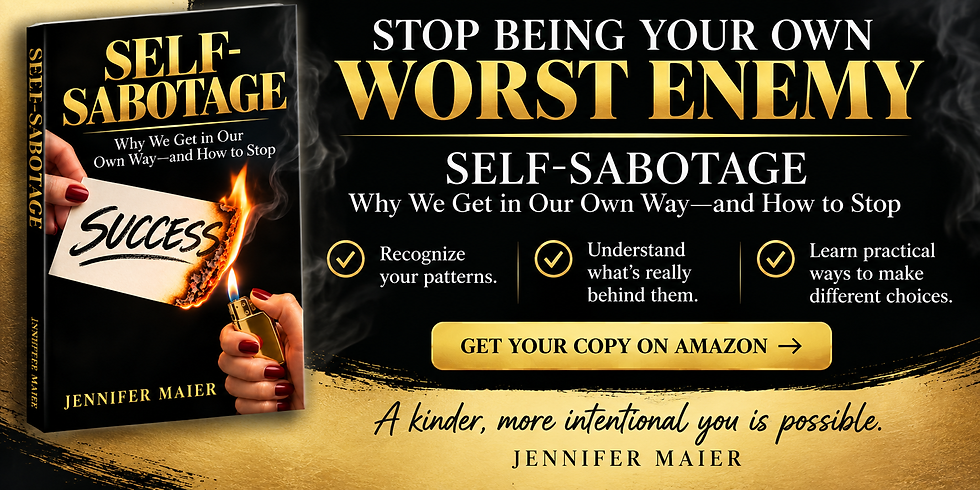
This is what makes self-sabotage so frustrating. We usually aren't trying to ruin our own lives. We want the thing. We want to save the money, finish the project, have the conversation, change the habit, apply for the opportunity or finally do whatever we've been talking about doing since everyone was still saying “unprecedented times.” Then the moment arrives when wanting requires participation, and suddenly we discover seventeen excellent reasons why today may not be ideal. The manuscript describes this contradiction plainly: we can sincerely want something while still participating in preventing ourselves from having it.

For a long time, I think we've explained this kind of behavior too simply. We tell ourselves we need more discipline, more motivation or considerably more backbone. Sometimes we probably do need to put the phone down and get on with it. But self-sabotage gets much more interesting when we ask a different question: What am I getting from not doing the thing I say I want to do? Putting off the application means I don't have to be rejected today. Continuing to polish the project means nobody gets to judge the finished version yet. Avoiding the conversation lets me enjoy another peaceful afternoon. The long-term result may work against me, but the short-term result can feel surprisingly good.
That explains why self-sabotage can occasionally show up wearing a very responsible outfit. It can look like research. Preparation. High standards. Taking care of everybody else's priorities before attending to your own. It can look like waiting until you know more, feel more confident, have more time or finally achieve the mythical state known as “ready.” You can spend six months preparing for something and feel extremely productive because everything you're doing is technically related to the goal. At some point, though, another article isn't preparation. It's a very sophisticated hiding place. The book makes the distinction between preparing for participation and using preparation to postpone the moment when reality gets a vote.
I particularly appreciate perfectionism's contribution to this problem because perfectionism has excellent public relations. Nobody says, “I'm avoiding finishing because once this leaves my hands, other people can have opinions about it.” We say, “I have high standards.” And perhaps we do. But there comes a point when we stop fixing actual problems and begin wandering around with a magnifying glass hoping to locate another one. Excellence wants the work to be good. Perfectionism can make “good” impossible to recognize, which is terribly convenient if finishing is the part that scares us.
Procrastination has its own respectable disguises. Sometimes waiting is exactly the right thing to do because we're missing information or circumstances genuinely need to change. But sometimes we're waiting for confidence, motivation, perfect timing, a completely free weekend or some future version of ourselves who wakes up eager to do unpleasant things. She sounds wonderful. I have never met her. Confidence, particularly, has a nasty habit of arriving after we've done the thing we thought we needed confidence to begin. We try, feel awkward, learn something, try again and eventually discover that what once frightened us has become manageable.
This is where I think shame becomes especially unhelpful. If every instance of procrastination means I'm lazy, every abandoned plan means I'm a quitter and every nervous retreat means I'm a coward, I've turned a behavior into an identity. Now I don't merely have something to change; apparently, I need an entirely new personality. The book takes a much more useful position: self-sabotage is a pattern, not a personality. Once we stop putting the whole person on trial, we can examine the particular choice that keeps occurring and ask what immediate benefit keeps making it attractive.
And that leads to two questions I think are worth carrying around: What does this choice give me now, and what might it cost me later? Maybe not sending the email gives me relief tonight but costs me the possibility the email could create. Maybe buying something makes a bad afternoon better, but chips away at something I'm saving for. Maybe saying yes prevents somebody's disappointment today while giving tomorrow's version of me another obligation she absolutely did not request. Asking the questions doesn't mean the long-term goal always wins. Sometimes the purchase is worth it, the evening off is necessary, the opportunity is wrong or the goal itself needs to change. The point is to make an actual decision instead of automatically reaching for whatever makes the next five minutes easier.
That is why the alternative to self-sabotage in the book isn't relentless achievement. It's self-advocacy. An advocate isn't a drill sergeant following you around demanding greater productivity. She represents your interests. Sometimes she tells you to send the application. Sometimes she tells you to go to bed. Sometimes she says the work is ready, the boundary needs to hold, the goal needs another attempt—or that you've learned enough and it's time to walk away. Your fear gets a voice. Your need for immediate relief gets a voice. But the life you say you want gets representation too.
Maybe that's the shift that matters most. Instead of spending all our energy asking, Why do I keep doing this to myself? we can begin asking, What would it look like to work on my own behalf here? The answer may be remarkably ordinary. Send the email before you can rewrite it again. Return after the bad day instead of waiting for Monday. Ask for help. Let ninety-five percent be finished. Look at the number you've been avoiding. Take the smaller step rather than abandoning the direction entirely. Those choices don't look much like transformation from the outside, but repeated often enough, they begin creating evidence that you're no longer automatically standing between yourself and the life you want.
Perhaps getting out of your own way doesn't require becoming a completely different person after all. Maybe it means becoming a little more suspicious of the tiny, reasonable-sounding choices that repeatedly leave you farther from what you say matters—and a little more willing to give your future self a seat at the table.
Because she has to live with whatever today's version of you decides.



Comments