Apparently, My Brain Is Keeping Score

There are apparently two versions of my life. There is the one I am actually living, and then there is the official record being maintained somewhere in my brain. I have recently discovered that my brain is keeping score, and I have some serious concerns about the bookkeeping. Compliments appear to be nonreportable income. Accomplishments depreciate almost immediately. Kind things I've done are routinely excluded from the calculation. But an awkward remark I made fifteen years ago? That sucker has been carefully preserved, indexed and remains available for review at approximately 1:13 in the morning, usually when I was doing something completely unreasonable like trying to sleep.
I can be having a perfectly respectable day when the accounting department decides we need to revisit one of these outstanding items. Perhaps I said something slightly awkward three hours earlier. At the time, nobody gasped, nobody left the room, security was not called, and the conversation simply moved on as conversations tend to do. Later, however, my brain clears its throat and suggests that we take another look. Suddenly I'm wondering whether I sounded stupid, whether she looked at me strangely, whether that pause was longer than usual, and why he said “okay” instead of “sounds good.” Before long, I have taken one completely ordinary interaction and constructed a surprisingly detailed case for why everyone involved may now have concerns about me as a person.
This is one of the more impressive talents of negative self-talk: its ability to turn remarkably little information into an elaborate conclusion. The mind can take a pause and turn it into disapproval, a mistake and turn it into evidence, or an uncertain outcome and confidently supply the ending we fear most. The trouble is that the voice doesn't usually sound ridiculous while we're listening to it. It sounds responsible. It tells us we're merely being realistic, reviewing the conversation so we don't make the same mistake again, or imagining seventeen catastrophic outcomes because it's important to be prepared. Apparently, the only thing standing between us and complete societal collapse is our willingness to lie awake reconsidering an email.

Negative self-talk is wonderfully efficient because it rarely bothers with a proportionate response when a sweeping indictment is available. Forget where you put your keys and the problem isn't simply that you can't find your keys; you're becoming incapable. Leave the laundry unfolded and apparently you can't keep up with anything. See an unflattering photograph and suddenly we're conducting a comprehensive review of how badly you've aged. Someone doesn't immediately answer your text and the relationship may very well be over. The actual event can be tiny while the conclusion somehow acquires a staff, a budget and subpoena power. The emotional reaction may be real, but the story producing it may not be. Misplacing your keys is a fact. Turning the misplaced keys into proof that you are an incompetent adult whose life is rapidly unraveling is additional material supplied by the narrator.
My brain also has an interesting policy regarding evidence. Criticism is admitted immediately and without question, while compliments are subjected to an extensive background check. Tell me I did something well and there are explanations: you were being nice, you didn't see the mistakes, perhaps your standards are unusually low. But let somebody offer one mildly critical observation and suddenly we have located the only reliable witness in the building. The same pattern appears in the manuscript: if praise is routinely dismissed while criticism receives automatic credibility, we're not evaluating the evidence evenly; we've created a system that permits only one conclusion.
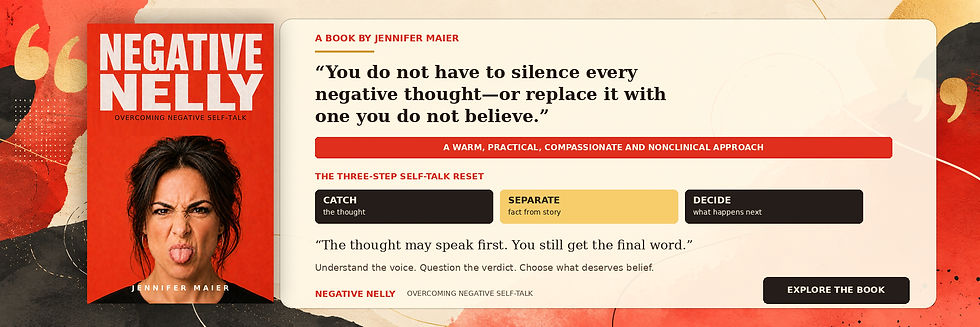
The answer, at least for me, isn't to replace every negative thought with something aggressively cheerful. If I make a mistake, I don't need to stand in front of a mirror chanting that I am flawless and magnificent. Sometimes I did screw up. Sometimes I should apologize. Sometimes I procrastinated, handled something badly or ignored something I knew needed attention. The useful distinction is between accountability and humiliation. “I handled that poorly” gives me somewhere to go. “I ruin everything” gives me a dramatic sentence and absolutely no instructions. As Negative Nelly explores, self-punishment can feel productive because the emotion is intense, even when it does nothing to repair what actually happened.
So I've become interested in responding to my internal scorekeeper with something less dramatic than either surrender or war: Okay, what have you actually got? Is there a fact here? Is there something I need to fix? Is there information I need to gather? Or have we pulled the same file out of storage for the 247th time and discovered, once again, that nothing new has been added? Completed thinking does not become more complete simply because we repeat it, and there comes a point when reviewing the same old evidence is no longer reflection. It's just overtime.
I don't expect my brain to stop keeping score altogether. It seems far too committed to the position. But I am becoming considerably more interested in auditing the books. If the mistakes are going into the ledger, so are the things I handled well. If criticism counts, compliments don't automatically get thrown out. If one bad decision is evidence, then years of perfectly decent decisions are evidence too. My mind is welcome to keep its records, but it no longer gets to decide which pages belong in the file. A thought may speak first, as the book says, but that doesn't mean it gets the final word.



Comments