You Don’t Need More Rest. You May Need Less to Recover From.

There is a particular kind of exhaustion that a good night's sleep does not fix. You can sleep eight hours, spend Sunday afternoon on the sofa, take a long bath, cancel plans, order dinner instead of cooking it, and still wake up Monday morning feeling as though someone forgot to recharge you. So you begin wondering whether you are resting incorrectly. Maybe you need a better bedtime routine. Maybe you need to exercise more, drink more water, meditate, take vitamins, spend less time on your phone, or finally become one of those women who owns matching pajamas and goes to bed at 9:30. But what if rest isn't the problem? What if you are trying to recover from a life that begins draining you again the moment you get up?
There is a difference between being tired because life has been unusually demanding and being tired because you have become the person who absorbs the demands. You remember what everyone else forgets. You notice what needs doing before anyone asks. You answer the text. You make the appointment. You fix the mistake because explaining how to fix it would take longer. You smooth over the uncomfortable moment. You say yes because you know the request is legitimate and because, technically, you probably can squeeze it in. Eventually, being capable stops feeling like one of your strengths and starts feeling like an unpaid position you somehow accepted for life.

The strange thing is that from the outside, this arrangement can look remarkably successful. Things get done. Birthdays are remembered. Deadlines are met. People receive help. Problems disappear before they become emergencies. You may even be praised for being dependable, organized, generous, calm under pressure, or the person everyone can count on. Meanwhile, the cost accumulates somewhere nobody is measuring: inside the person making everything work. That is why exhaustion can become confusing. Nothing appears dramatically wrong, yet increasingly you find yourself wanting one thing more than almost anything else: for nobody to need anything from you for a little while.
That feeling deserves more attention than we usually give it. We tend to interpret it as irritability or selfishness. We tell ourselves we should be more patient because the people asking things of us are not necessarily doing anything wrong, and often they aren't. But a person does not have to be unreasonable for a pattern to be unsustainable. Someone can genuinely need help while you genuinely do not have the capacity to provide all of it, and both things can be true at once.
This is where the usual advice about burnout begins to feel inadequate. Rest is important—absolutely—but a Saturday afternoon off cannot compensate for a life in which your attention is considered permanently available. A vacation cannot fix a workload that requires twelve hours of labor in an eight-hour day. A bubble bath cannot redistribute caregiving among four siblings. A better planner cannot solve the fact that everybody waits for you to notice what needs to happen next. Sometimes what looks like a need for more self-care is actually a need for less to recover from.
That may mean looking at the invisible work as seriously as the visible work. The appointment may take an hour, but how long did you spend remembering it, arranging it, preparing for it, worrying about it and handling what came afterward? The phone call may last twenty minutes, but did the conversation occupy your thoughts for the next three hours? The favor may take only fifteen minutes, but are you always the person expected to notice that the favor needs doing? Time is relatively easy to count. Mental and emotional availability are much harder, which is one reason we underestimate how much of ourselves we are spending.
Then there is the question many reliable people rarely ask: Does all of this actually belong to me? That is different from asking whether you can do it, because you probably can. It is different from asking whether it would be easier if you handled it, because it very well might be. It is even different from asking whether the problem matters, because it may matter enormously. The real question is whether noticing a need automatically makes you responsible for meeting it. We blur those two things so easily that eventually another person's problem can arrive in our lives already wearing our name tag.

That doesn't mean becoming uncaring or refusing to help people you love, and it certainly doesn't mean protecting every spare minute as though generosity were a personal attack. There will be seasons when love asks a great deal of us. There will be emergencies, illnesses, deadlines, grieving friends, aging parents and people who genuinely need more than usual. The problem begins when the exceptional season quietly becomes the permanent arrangement—and nobody notices because you keep making it work.
A boundary, then, is not necessarily a dramatic declaration that somebody has crossed a line. Sometimes it is simply an honest decision about how much of yourself you can continue to give. It may sound like, “I can help with this part, but I can't take over the whole thing.” It may mean waiting until morning to answer something that is not actually an emergency. It may mean allowing another capable adult to remember, decide, organize or occasionally struggle without rushing in to make the discomfort disappear. And yes, somebody may be disappointed, which for people who have built an identity around being dependable can feel almost like evidence of wrongdoing.
But disappointment and harm are not the same thing. Sometimes someone is disappointed because an arrangement that worked very well for them no longer works for you. Learning to tolerate that discomfort may be part of learning to protect your own capacity. It does not require becoming cold, selfish or indifferent. It requires recognizing that care can include you, too, and that generosity becomes difficult to sustain when it is built on one person's continual depletion.
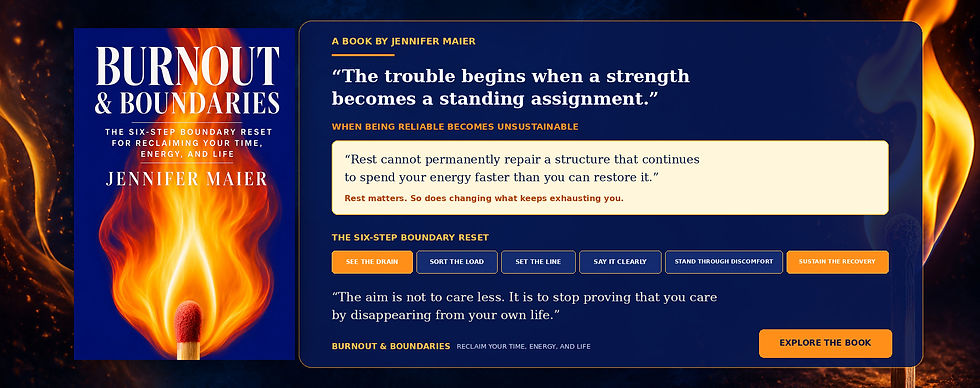
If you are exhausted, perhaps the first question isn't simply, How can I get more energy? A better question may be, Where is my energy going? Once you answer that honestly, another question becomes possible: Does all of it have to keep going there? Those questions shift the focus away from becoming better at enduring an unsustainable arrangement and toward examining the arrangement itself. Sometimes recovery begins not by adding another form of rest, but by finally deciding what you no longer need to recover from.


Comments